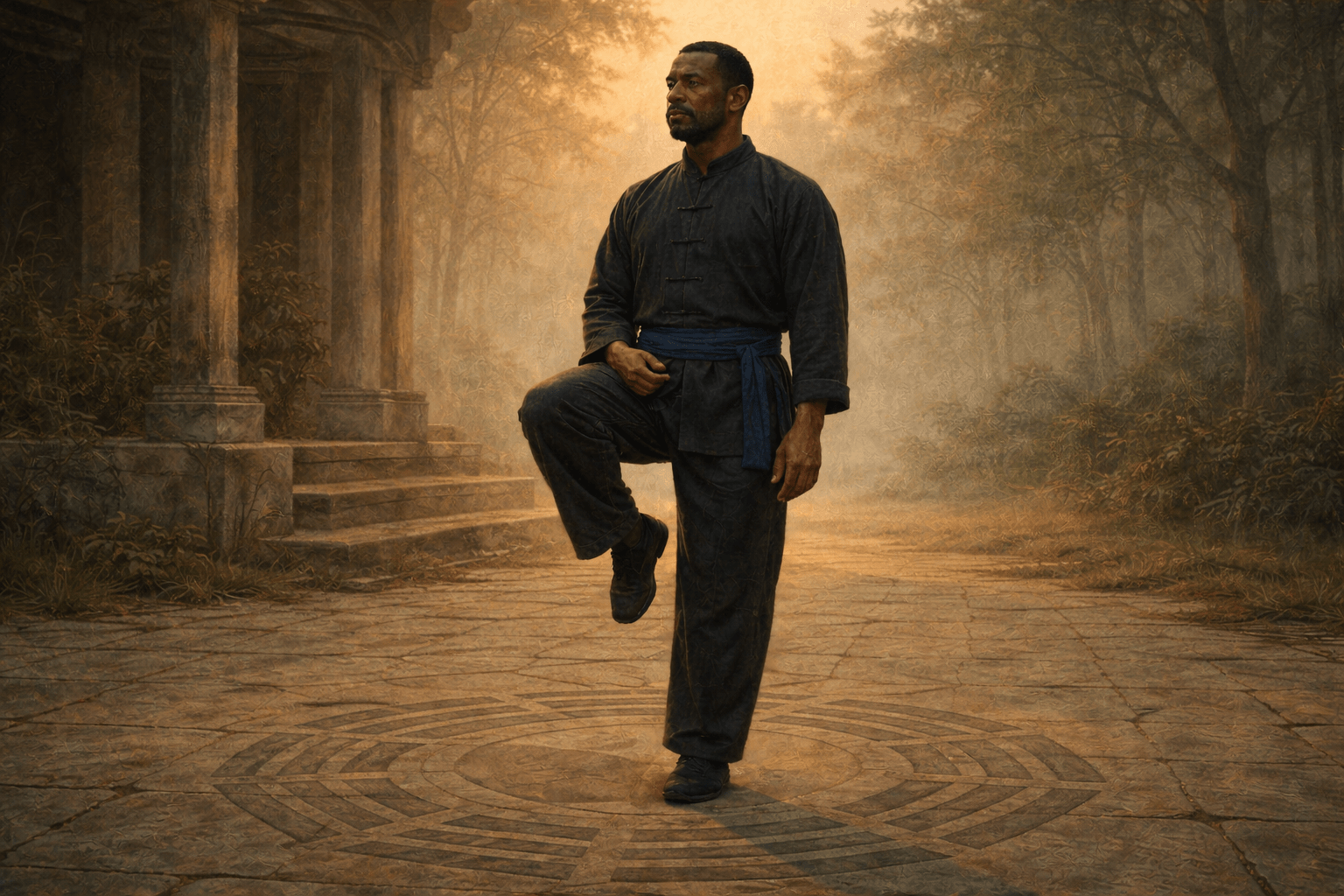
This morning I stood to put on my socks, one foot grounded, the other hovering, and noticed more resistance than usual—not from balance slipping but from reach shortening, hips and low back holding onto work done honestly over recent days—and I paused long enough to register the signal without arguing with it.

Stiffness didn’t complain.
It informed.
Later, during warm-up kicks, the message completed itself.
A few lifts in, the knee refused heights it reached easily just days ago, not through pain or instability but through stiffness settling deeper into the hips, effort still processing, tissue still reorganizing itself after training that asked real questions of the system, and memory tried to rush the present with expectations it hadn’t earned.
I trained.
I loaded the system.
Now the system recalibrates.
Muscles don’t simply recover; they adapt through rehydration, re-patterning, and time that resists negotiation, sometimes resolving quietly overnight, sometimes asking for patience we forget to budget when progress feels good, and when the mind whispers, You lifted higher last week, irritation arrives ready to mislabel information as decline.
Nothing failed.
Nothing reversed.
Nothing disappeared.
I reached the hinge between effort and integration.
Warm-up kicks don’t measure worth; they reveal readiness, and readiness speaks clearly to those who cultivate training literacy—the ability to read signals without dramatizing them, to distinguish fatigue from injury, stiffness from loss, adaptation from regression—so instead of forcing yesterday’s range onto today’s tissues, I lowered height, slowed tempo, let the pelvis organize before demanding lift, and stayed loyal to clean mechanics rather than borrowed memory.
That choice didn’t signal retreat.
It signaled fluency.
Training literacy matures alongside the body, especially as years accumulate experience faster than they restore tissue, teaching us that strength expresses itself in waves, flexibility returns by invitation, and patience belongs to discipline itself—not as a concession to age, but as its refinement.
High expectations require high recovery intelligence.
So the session continued—quieter, more precise, breath leading where muscle hesitated—and as often happens, range softened gradually, not because I demanded compliance, but because I allowed the system to complete the conversation it started hours earlier.
If something in your training feels temporarily unavailable, don’t rush to fix it.
Read it first.
Adjust with intelligence.
Return with respect.
That counts as training.
Stay inspired—and stay inspirational.
— Sifu Khonsura Wilson


 Musings on Martial Arts, Taoist Philosophy & All Things Wellness Related.