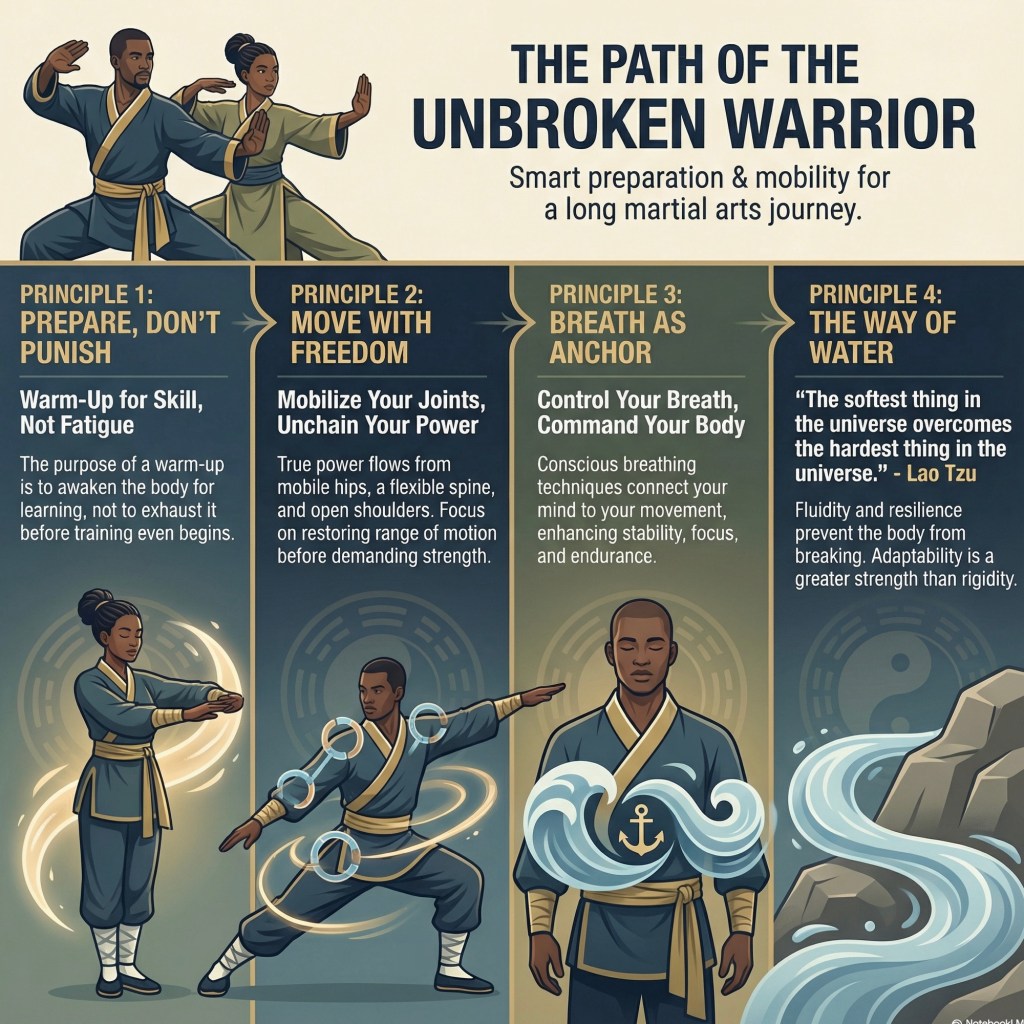
.A martial arts warm-up exists to prepare the body and the attention so training can happen safely, clearly, and with intention. It does not exist to exhaust students. Fatigue belongs elsewhere. Skill requires freshness. This distinction appears again and again in classical sources. The Tao Te Ching reminds us:
“Those who hurry do not arrive. Those who strain do not endure.”
A warm-up that rushes the body into exhaustion undermines the very training it claims to support. A warm-up done well clears the path so that learning can proceed without resistance.
This structure reflects traditional martial training logic—found across Shaolin, internal arts, and classical systems—while remaining practical for modern students who balance training with work, age, injury history, and recovery.
Phase 1 — IGNITE
(5–8 minutes)
The purpose of ignition is simple: raise body temperature, increase circulation, and gently elevate the heart rate.
Ignition movements wake the nervous system without draining the energy needed for learning. They replace stiffness with readiness and hesitation with rhythm.
This phase should feel light, repeatable, and steady. You should feel warm, not worked.
Examples include jumping jacks, light jogging, easy jump rope, or whole-body shaking. These movements reconnect the limbs to the center and remind the body how to move as a unit.
The I-Ching speaks to this moment through Hexagram 51, The Arousing (Thunder), which describes awakening without panic—
“Movement that stirs life but does not scatter it.”
That is the spirit of ignition.
Phase 2 — MOBILIZE
(8–12 minutes)
Once the body is warm, the joints must be prepared.
Mobilization restores usable range of motion and prepares the body for rotation, bending, and load. Martial arts ask the body to turn, coil, sink, and extend under control. This phase oils the hinges before they are asked to bear responsibility.
Mobilization moves deliberately from the ground upward: ankles, knees, hips, spine, shoulders, elbows, wrists, and finally the neck. Breath remains steady and unforced. Movements stay circular and attentive.
Here, patience becomes part of training.
The Tao Te Ching teaches:
“The soft overcomes the hard. The yielding overcomes the rigid.”
Joint preparation embodies this principle directly. Rushed force stiffens. Gentle attention opens pathways.
Phase 3 — INTEGRATE
(8–10 minutes)
Mobility alone does not produce skill. It must be organized.
Integration teaches the body to use its newly restored range with control and structure. This phase bridges warm-up and training, turning looseness into alignment.
Stances, slow kicks, controlled transitions, and posture coordinated with breath belong here. Nothing rushes. Nothing collapses.
This phase quietly reveals balance issues, asymmetries, and tension habits—both to the instructor and the student. It is diagnostic without being punitive.
The I-Ching captures this moment in Hexagram 53, Gradual Development, reminding us that:
“Stability grows through ordered steps, not leaps.”
Phase 4 — TRAIN (Skill Work)
(45–60 minutes minimum)
This is the heart of class.
Training includes forms, drills, applications, partner work, correction, and repetition carried out with attention. It requires sensitivity, responsiveness, and enough freshness to perceive subtle errors and make real adjustments.
Anything less than forty-five minutes of focused skill work turns training into demonstration. Anything overloaded with fatigue turns learning into survival.
Class time prioritizes clarity.
As the Tao Te Ching states:
“To know how to stop is to be preserved from danger.”
Stopping short of exhaustion preserves both technique and spirit.
Conditioning (Homework)
Conditioning strengthens the body and builds endurance, but it does not belong inside the main teaching block of class. It does three important things at once. It keeps the class focused on learning rather than exhaustion. It signals that endurance matters without forcing it on everyone. And it respects different bodies, ages, and recovery capacities without apology or compromise.
Placing conditioning outside class allows technique to remain clean, instruction to stay focused, and students to scale intensity safely according to age, recovery, and personal goals.
Conditioning performed as homework may include jump rope rounds, high-rep calisthenics, roadwork, stance endurance, or extended form practice. These efforts matter—but they matter most when chosen deliberately rather than imposed universally.
Strength grows through restraint and proper containment.
I-ching
This approach honors both discipline and longevity.
Why This Structure Matters
- This sequence protects joints.
- It preserves attention.
- It prevents burnout.
- It respects beginners.
- It supports long-term progress.
Most importantly, it teaches students how to train responsibly, not just how to move.
The I-Ching reminds us in Hexagram 26, The Taming Power of the Great, that strength grows through restraint and proper containment. Training that endures follows that wisdom.
If this structure affirms how you already train—or challenges habits you’ve taken for granted—that reflection itself counts as practice. You’re welcome to share your experience in the comments: how you warm up, what your body asks for before training, or what you’ve learned through time on the floor.
If this essay supported your understanding, feel free to like it or share it with someone you train with. And if you’d like to continue exploring martial arts through structure, tradition, and lived experience, you’re welcome to subscribe for future posts.
Begin well and train clearly, letting endurance come in its proper place.
Stay Inspired & Inspirational.
Sifu Khonsura R. Wilson

 Musings on Martial Arts, Taoist Philosophy & All Things Wellness Related.