
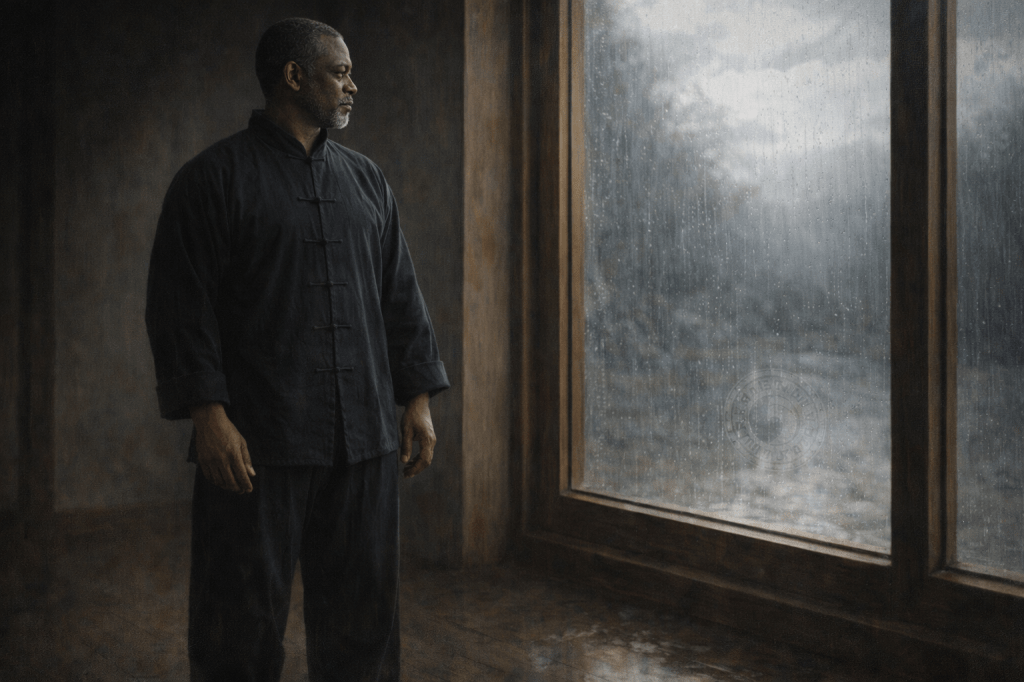
Rain fell this morning without asking permission, stitching sky to ground so gently that the seams disappeared as soon as they formed, a quiet labor carried out in gray light while the world still hesitated between sleeping and waking.
I watched it from the window, standing still long enough to notice how nothing announced itself, how no sound demanded attention, how the work completed itself without proof of effort, without residue, without applause. That stillness returned me, as it often does, to an old teaching from the Dao De Jing, one that carries more weight for me now than when I first encountered it, one that continues unfolding even after years of reading and practice.
Good walking leaves no tracks.
Good speech leaves no mark to be picked at.
Good calculation makes no use of counting slips.
At first reading, the passage sounds almost impossible, as if it praises erasure or invisibility, as if wisdom requires leaving no trace of having been present at all. I once misunderstood it that way, confusing restraint with retreat, alignment with absence. Life corrected that misunderstanding slowly, through teaching, training, collecting, writing, carrying—through years that asked not whether I could act, but whether I could act without damage.

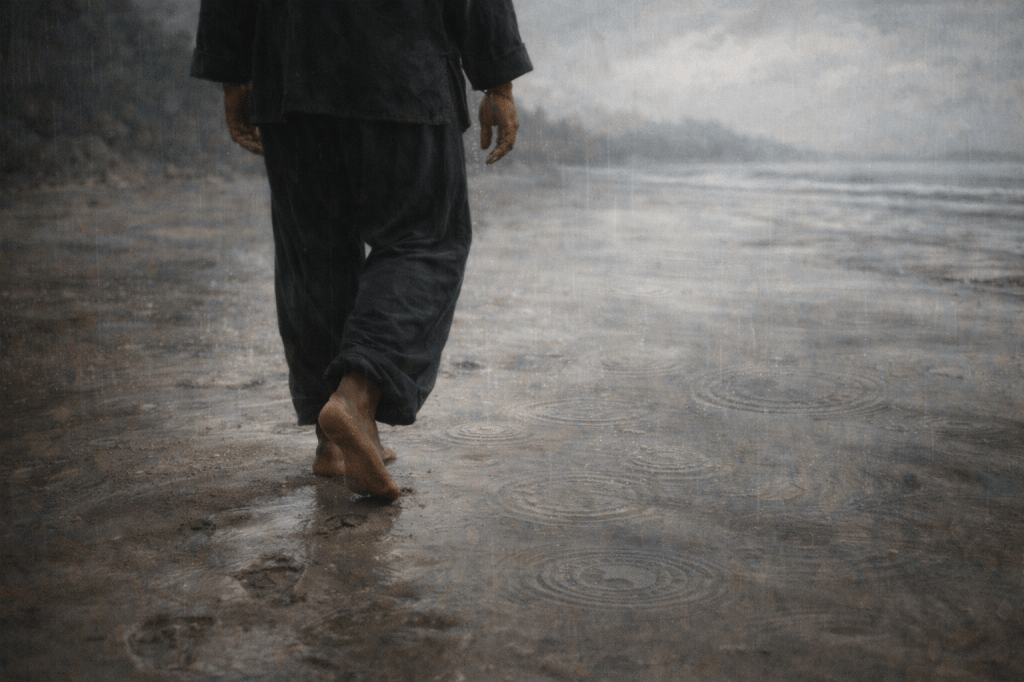
“Walking that leaves no tracks does not mean refusing to move. It means stepping in rhythm with the ground already beneath you.”
The text does not praise disappearance. It resists spectacle. It gestures toward fit—the kind of fit that emerges when action meets circumstance so precisely that resistance never gathers. Walking that leaves no tracks does not mean refusing to move. It means stepping in rhythm with the ground already beneath you.
This teaching sharpens when paired with another passage, one that appears not in the classical Dao De Jing itself but in William Martin’s The Sage’s Dao De Jing, often titled Forever Limitless. There, the distinction arrives cleanly and without ornament: the young confuse desire with passion and live in constant discontent, while the sage knows the difference and lives in peace and joy.
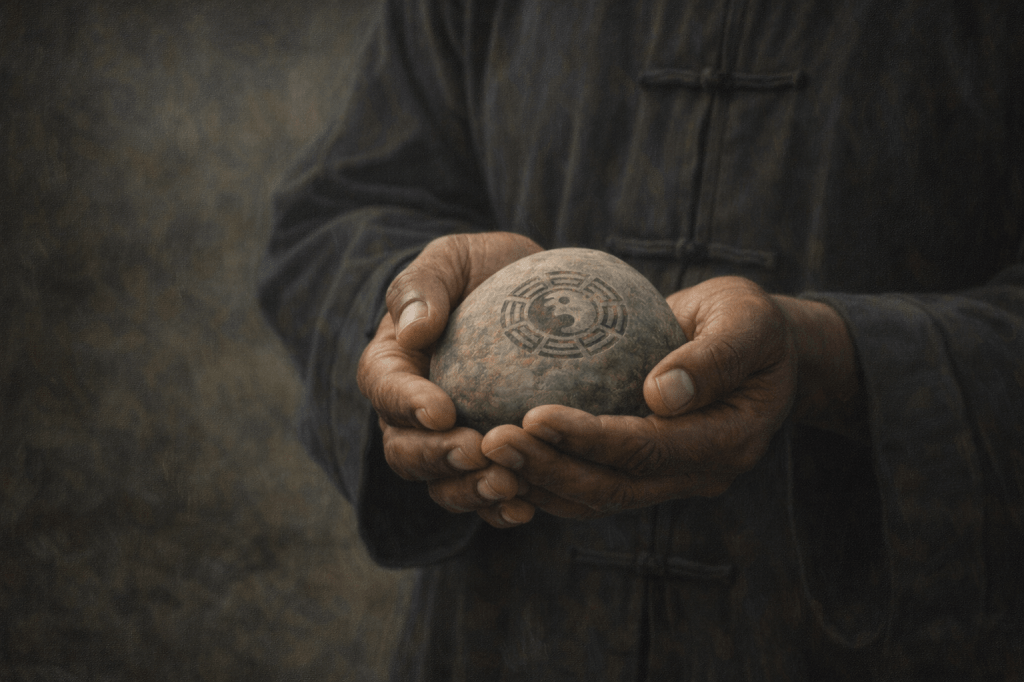
Desire narrows attention. It asks life to deliver something missing. Passion widens participation. It engages what already stands present, without insisting on possession. Desire tightens the field of vision, compressing experience into a checklist of satisfactions deferred. Passion moves differently, remaining alive even when outcomes resist control.
“Desire narrows attention. Passion widens participation.”
That difference explains why the sage, desiring nothing, enjoys everything—not because he owns less, but because he clings less, allowing moments to arrive, ripen, and pass without being pinned down for proof. Possessing nothing does not require poverty. It requires loosened grip.
I feel this tension most clearly when I look at my shelves, rows of books gathered over decades, each one marking curiosity, hunger, faith in a future self who would eventually arrive ready. The question returns, as it often does: Should I reduce? Should I let go? Not because the books weigh too much physically, but because they sometimes whisper unfinished obligation.

The Dao does not instruct indiscriminate clearing. It asks a subtler question: Does what you carry still move through you, or does it wait for you to prove something to it? Knowledge absorbed no longer needs storage. What changes us continues its work even when the object rests elsewhere.
“Possessing nothing does not require poverty. It requires loosened grip.”
This question widens naturally as the year edges toward its close. Cultural rituals encourage accounting—lists compiled, resolutions drafted, narratives tightened to justify the passing months. But the Dao suggests another posture, quieter and more demanding: attention to where movement aligned so fully that nothing required repair afterward.
Good shutting needs no bolt.
Good untying uses no knot.
What aligns does not require defense.

This teaching does not dismiss effort; it disciplines it. It invites a way of living that saves people without sorting them into failures and successes, that saves things without hoarding them, that refuses to abandon what moves slowly or awkwardly toward usefulness. Intelligence alone cannot do this work. Reverence must accompany it—reverence for teachers, for students, for unfinished forms.
“What aligns does not require defense.”
Rain still falls without asking permission, stitching sky to ground with the same patient repetition, landing and disappearing before the eye can claim it. No announcement follows. No record remains. Yet the world feels held together a little longer because of it. As this year loosens its grip and prepares to release us forward, I find myself less interested in what I accumulated than in how I moved—where my steps matched the ground, where my words left no bruise, where attention replaced control.

“Perhaps the work does not ask us to leave marks at all, but to pass through moments so aligned that nothing needs undoing afterward.”
If this reflection stays with you, let it do so quietly. Carry it into one ordinary moment today—a conversation, a task, a decision—and notice what happens when you move without leaving marks that require explanation later. No response required. No declaration necessary. Just one clean step taken in rhythm with the ground already beneath you.
Stay inspired & inspirational,
Sifu Khonsura Wilson

 Musings on Martial Arts, Taoist Philosophy & All Things Wellness Related.