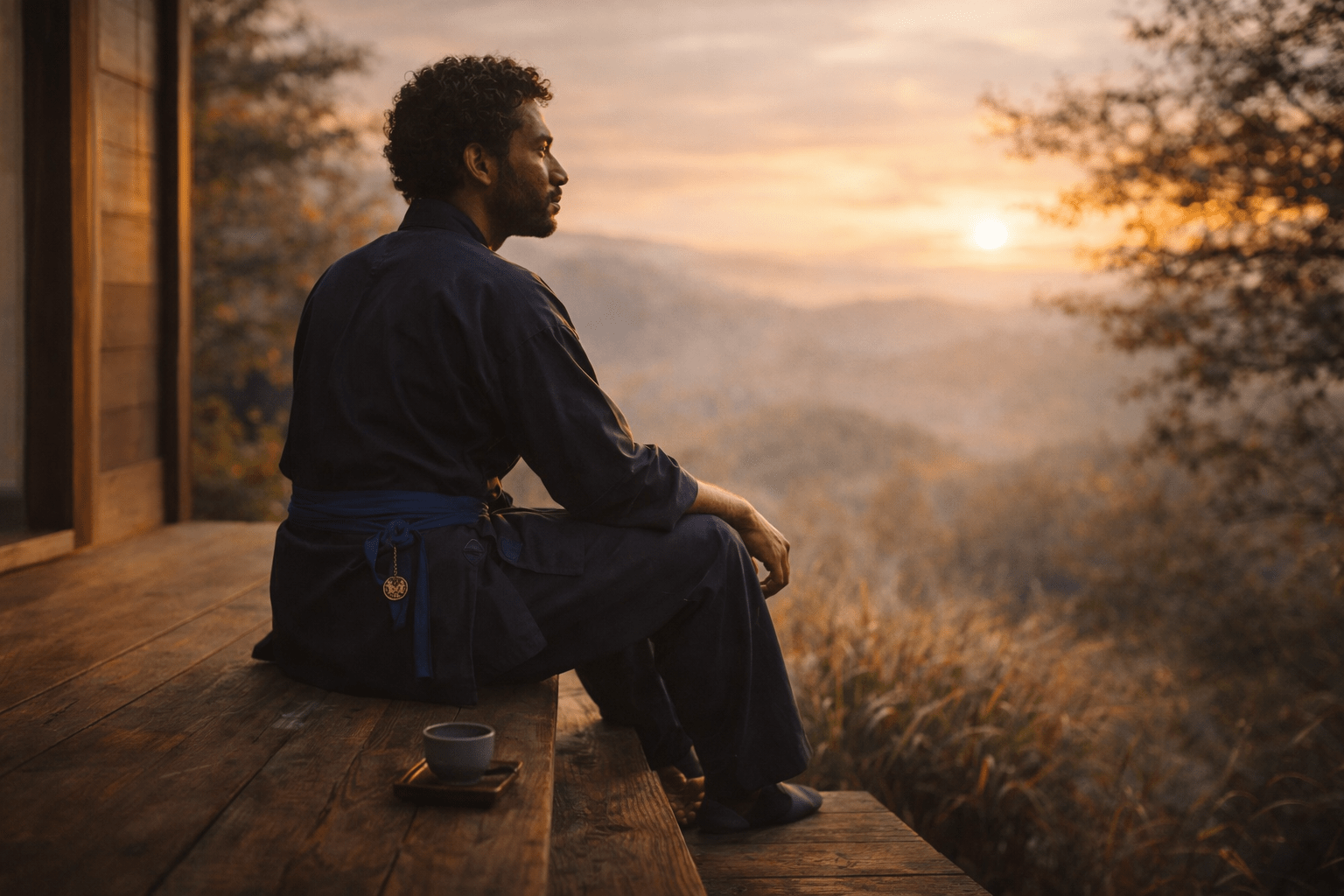
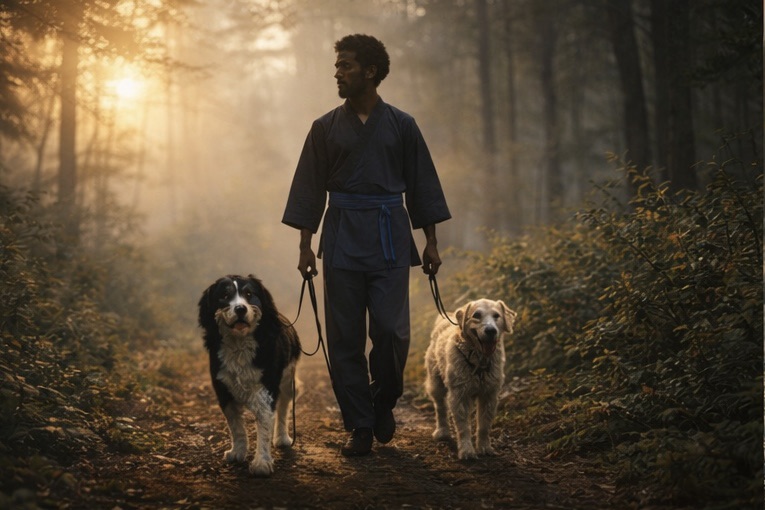
I didn’t set out to learn anything profound today; I set out to unstiffen—to walk the dogs, sip sunlight, shake travel out of my calves, and let the ordinary reassemble itself, one footfall at a time, while my mind wandered the way a tired hound wanders, sniffing at every thought like it might carry a scrap of meaning. Somewhere between movement and stillness—between training and refusing to bully my own body into obedience—I caught an extra effort riding on my shoulders like a backpack I never consciously strapped on, effort not only in muscle and tendon but in attention itself, in the forward-lean of my thinking, in that reflex to hunt a takeaway and turn quiet into product.
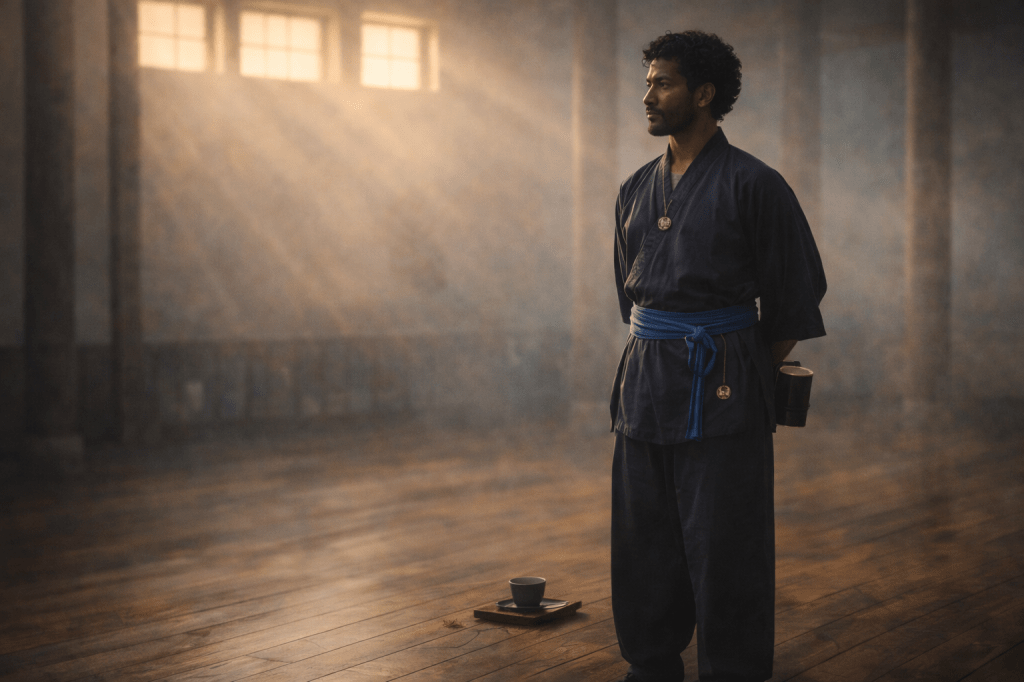
“Do the work; then step back.”
That pressure had grown familiar lately, so familiar I almost renamed it discipline, because reflection began demanding performance, insight began demanding outcomes, reading began demanding application, and the inner voice kept whispering, So what will you do with this?—a little hustler-question in a silk robe, pretending it carried wisdom. I kept walking anyway, letting the question trail behind me like a kid tugging my sleeve, and the longer I walked the more its grip slackened, because some things resist extraction, refuse leverage, dodge proof, and ask instead for breath, body, lived time; once I stopped squeezing every moment for juice, the day widened, quietly, like a tight belt unfastened after a long drive.
“Nature does not hurry, yet everything gets accomplished.”
Tai Te Ching
Earlier, I opened 365 Tao: Daily Meditations by Deng Ming-Dao, then turned to the Tao Te Ching—Chapter 34 in one translation, and later a passage from William Martin’s The Sage’s Tao Te Ching and that old description of the Tao met me again—vast and universal like a flood—nourishing without bragging, carrying without claiming, doing the work without demanding applause, feeding and clothing the ten thousand things without lording over any of them. The passage kept pointing toward a paradox that tamps down my ego in the gentlest way: greatness completes itself through refusal of grandstanding, and power ripens through quiet anonymity, roots holding the whole tree upright while no one claps for roots.

“The highest good resembles water.”
Tai Te Ching
That thought followed me through the afternoon—not as a lecture, not as a moral poster on a wall, but as a living question walking beside me: what might my day feel like if I moved through it without insisting on greatness, pushing for proof, or trying to win at existence? I don’t mean shrinking, and I don’t mean performing humility with a hidden hunger for compliments; I mean stepping forward with a relaxed jaw, working with clean effort, showing up to live the day instead of conquering it. Modern life trains us to confuse force with effectiveness—push harder, post more, sharpen the opinion, optimize the routine, tighten the timeline—until creativity wears a necktie and carries a clipboard, checking its own pulse, asking the algorithm for permission to breathe; I’ve watched that training take hold in me, especially around output, where “great” can sound like a spiritual goal while behaving like a small addiction.
Later, I opened William Martin’s The Sage’s Tao Te Ching, and his phrase—“agent of grace”—struck the same chord from a different angle: welcome in inhospitable places, no threat in the posture, no harm in the hands, people softening without coercion, minds opening without argument, kindly words moving where crowbars fail, families shifting through warmth instead of warfare. I didn’t take that as moral instruction; I took it as a reading on temperature. Some people step into a room and the air tightens—shoulders rise, jokes thin out, everybody braces. Others arrive and the room relaxes—faces open, voices soften, time slows enough for truth to slip through. Nothing mystical required, only presence, posture, tone, and a subtle decision to enter with no spear hidden behind the smile.

“A soft tongue can break a bone.”
Tai Te Ching
Then the day put its own evidence on the table, plain and practical. Training improved the moment I softened my shoulders and let my stance widen a half-inch, the sequence switching from resistance to rhythm; planning cleared when I stopped stacking demands like dishes in a sink already full; reading deepened when I stopped interrogating every page for productivity. The yard asked for water, not renovation. The body asked for movement, not conquest. The mind asked for space, not answers. Even the dogs—honest snouts, unbothered priorities—kept reminding me that life never needs a résumé to count as real.
Grace, as the afternoon kept teaching it, doesn’t cancel effort; grace refines effort, turning action away from threat. Grace looks like influence without insistence, strength without swagger, the kind of strength that doesn’t photograph well because it doesn’t beg for witnesses. Force can win compliance, sure, but force rarely wins openness; force moves bodies, grace moves hearts, hearts move habits, habits move futures, and that chain matters more than the short-term satisfaction of “winning” a moment.

“The soft overcomes the hard.”
Tai Te Ching
That recognition swung my attention outward, toward family gatherings, workrooms, classrooms, online spaces—places that harden fast when someone enters trying to win, correct, dominate, or impress, then soften when someone enters trying to understand, to listen, to contribute without tightening the air. Acting without lording over things doesn’t require disappearance; it requires refusal of domination’s posture, refusal of the contest-mind, refusal of greatness as the goal, because greatness—chased directly—shrinks into performance, while greatness—approached sideways—widens into service. Something quietly radical lives there, a stance that refuses trend-chase and trophy-hunt, choosing steadiness over spectacle—no viral victory, no dramatic reveal, just disciplined softness that changes a room by refusing to threaten it.
By the time I turned back toward home, nothing resolved itself, and that felt right; the dogs slowed, the light slanted, my legs loosened, and the day kept walking beside me without demanding a conclusion. I didn’t gain a shiny new identity called wiser, and I didn’t earn anything notable enough for a highlight reel. I simply eased off the push for a while, and in that easing something essential returned—steadier stride, quieter mind, cleaner attention—and I remembered a truth modern life keeps trying to edit out: usefulness doesn’t always announce itself as success.
Sometimes usefulness arrives as grace—quiet, capable, unthreatening—doing the work, leaving the air softer than it found it.
Stay Inspired and Inspirational
Sifu Khonsura Wilson
Recommended Reading
Deng Ming-Dao, 365 Tao: Daily Meditations
Lao Tzu, Tao Te Ching (try multiple translations; each one turns the gem a little differently)
William Martin, The Sage’s Tao Te Ching: Ancient Advice for the Second Half of Life

 Musings on Martial Arts, Taoist Philosophy & All Things Wellness Related.