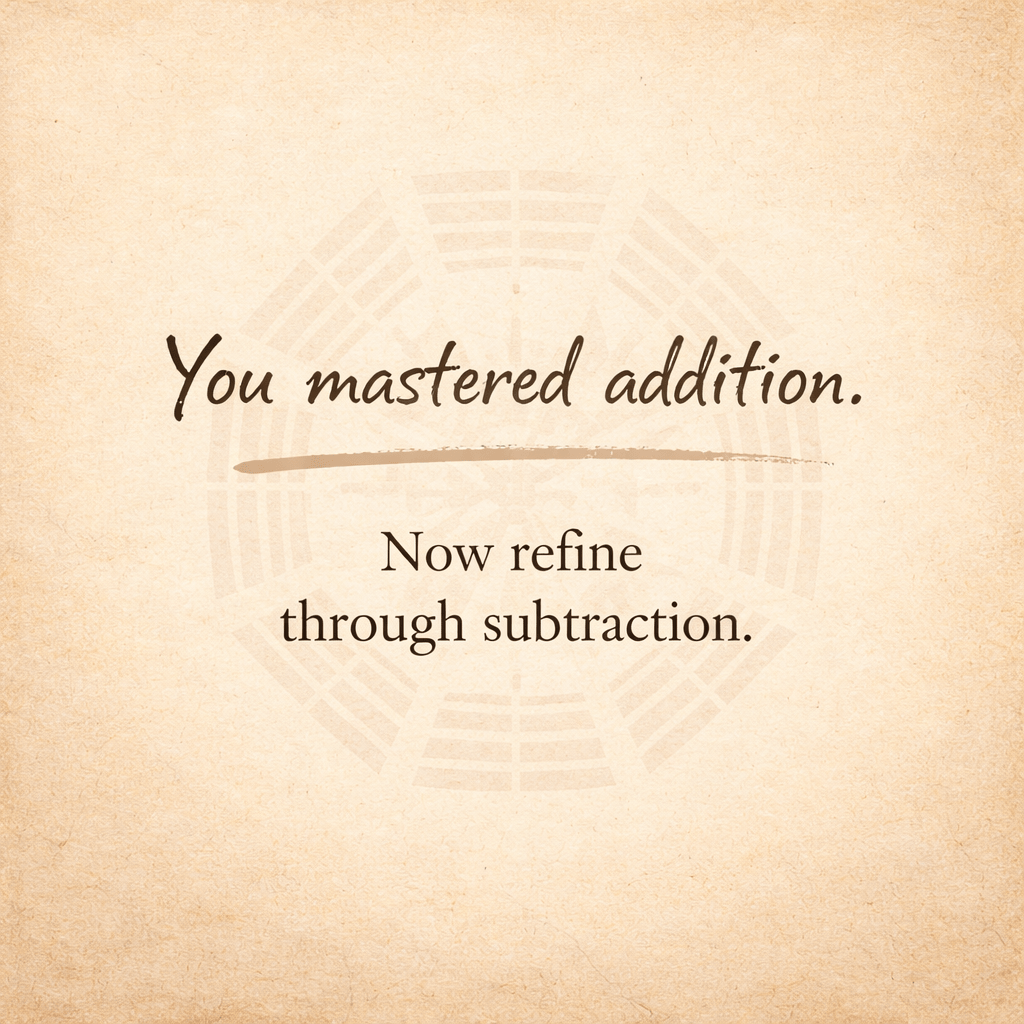
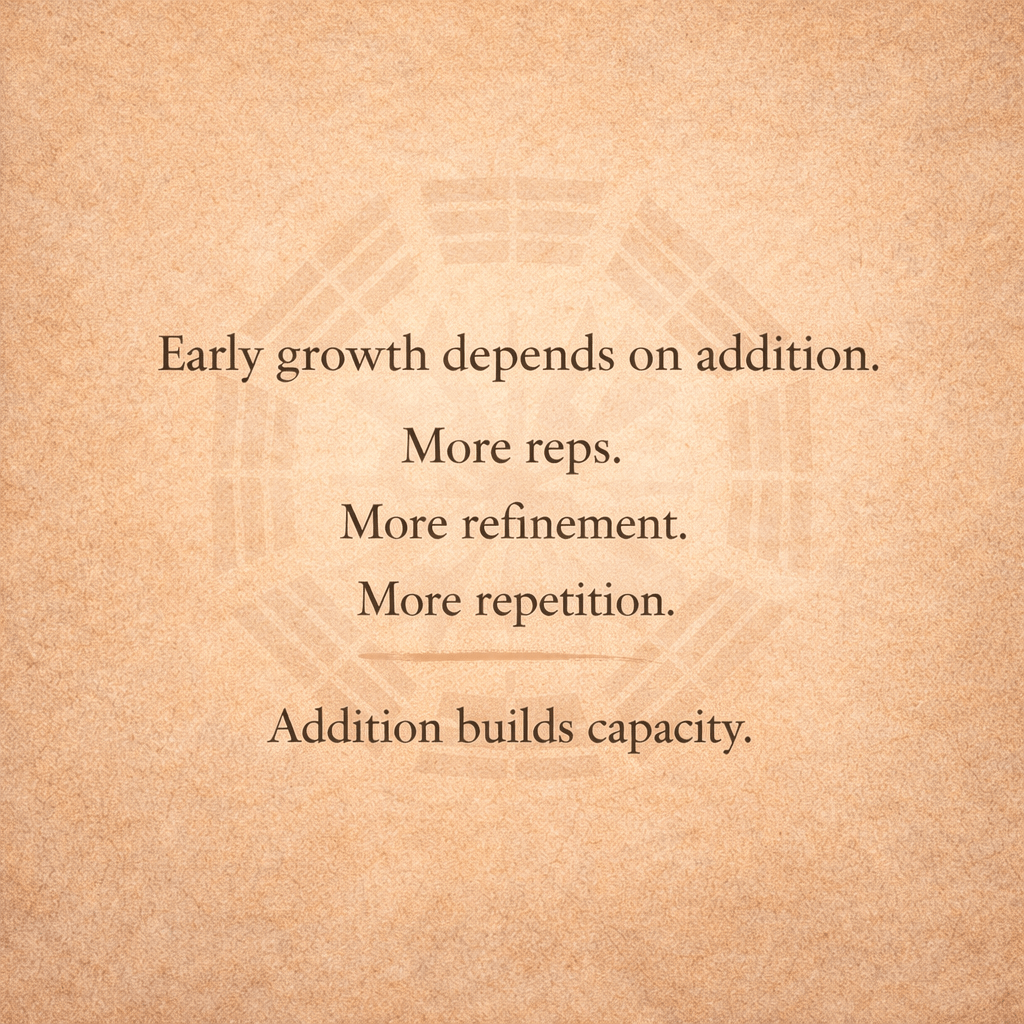
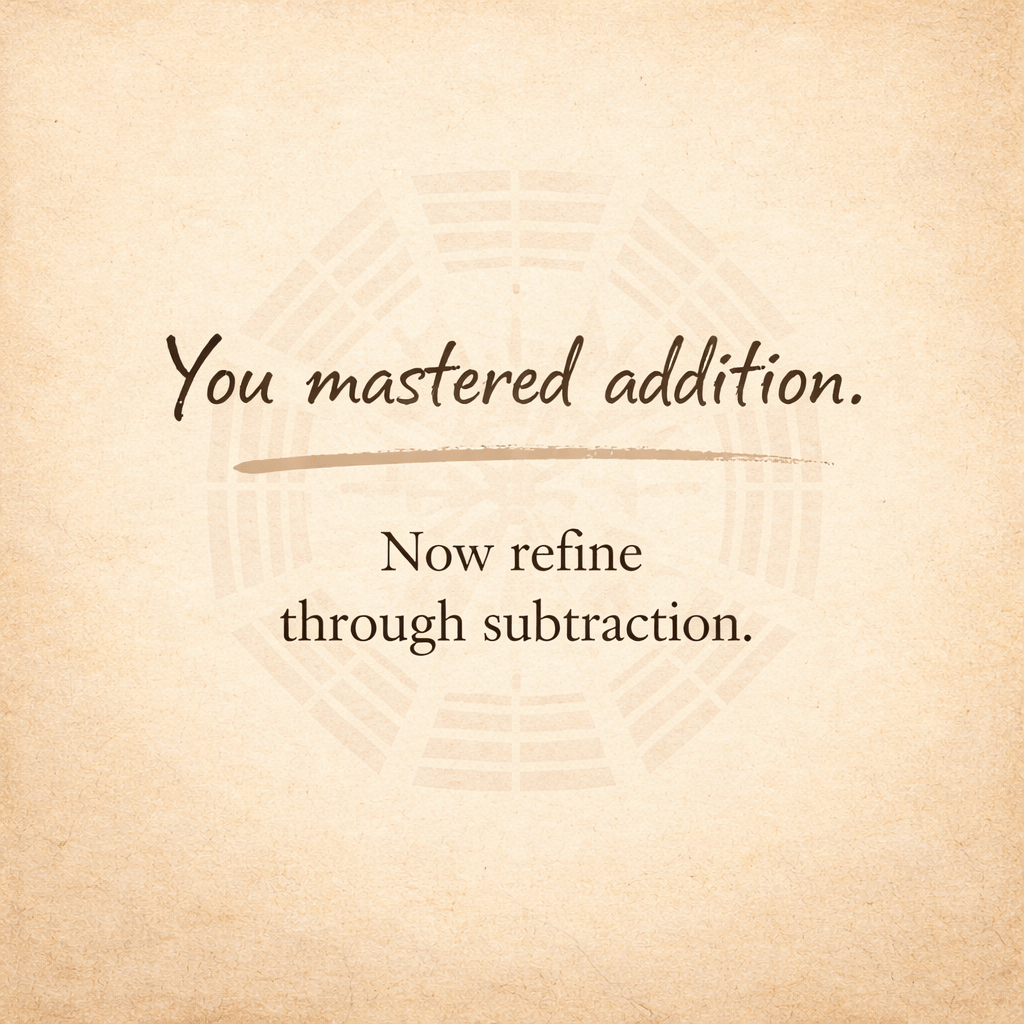
That line doesn’t flatter you. It recognizes a season you already survived, a season where you proved—through repetition, responsibility, and relentless return—that you could build a life with structure, build a body with practice, build a mind with study, build a name with consistency, and build an identity that held steady even when motivation wandered. Addition worked, and it worked for a reason. Early growth usually asks for more: more reps, more pages, more discipline, more refinement, more intentionality, and more willingness to show up when you don’t feel like it. You didn’t just “try.” You stacked days, and those days stacked you back.
But addition carries a quiet shadow.
Accumulation.
Every good thing that enters your life wants to stay, and when you keep every practice, every ritual, every plan, every “helpful” routine, the day starts to thicken. The schedule tightens. Completion gets crowded. And you can still move efficiently—checking boxes, honoring habits, running the system—while noticing a strange cost: the loss of permeability. You begin to feel like you live inside your own checklist, like you built a house of discipline and then forgot to leave windows open.
That’s where the Taoist pivot lands with surgical precision: when every minute gets accounted for, nothing new can enter. Insight needs margin. Creativity needs pause. The nervous system needs unstructured time to digest experience, to integrate emotion, to consolidate learning, to let wisdom settle rather than merely pass through. When the calendar absorbs every available inch of space, you can produce a lot and still feel inwardly tight, because you never left room for the unexpected gift—laughter that arrives unplanned, peace that drops in softly, a new thought that needs silence to form, a small joy that slips through only when you stop guarding the gate.
So Tao invites subtraction.
Not regression. Refinement.
In art, subtraction clarifies form. A sculptor doesn’t add marble to find the figure; the sculptor removes what doesn’t belong. A writer doesn’t always improve a paragraph by adding sentences; the writer sharpens meaning by cutting what muddies the point. A musician makes the notes hit harder by respecting the rests. In every case, subtraction doesn’t weaken the work; it defines it, it reveals it, it gives it shape and breathing room. The same principle holds in your training and in your daily life: tension slows the body, and release restores speed; over-activation scrambles the mind, and pause restores clarity.
Subtraction, in your context, means asking a more mature set of questions.
What is essential, and what is ornamental? What actually strengthens me, and what simply reassures me? What sustains my identity, and what props it up because I don’t trust myself yet? Because that’s the real test hiding underneath “do I have time?” The deeper question asks, “Do I trust myself enough to leave something undone without feeling like I failed?”
That question takes more courage than addition ever did.
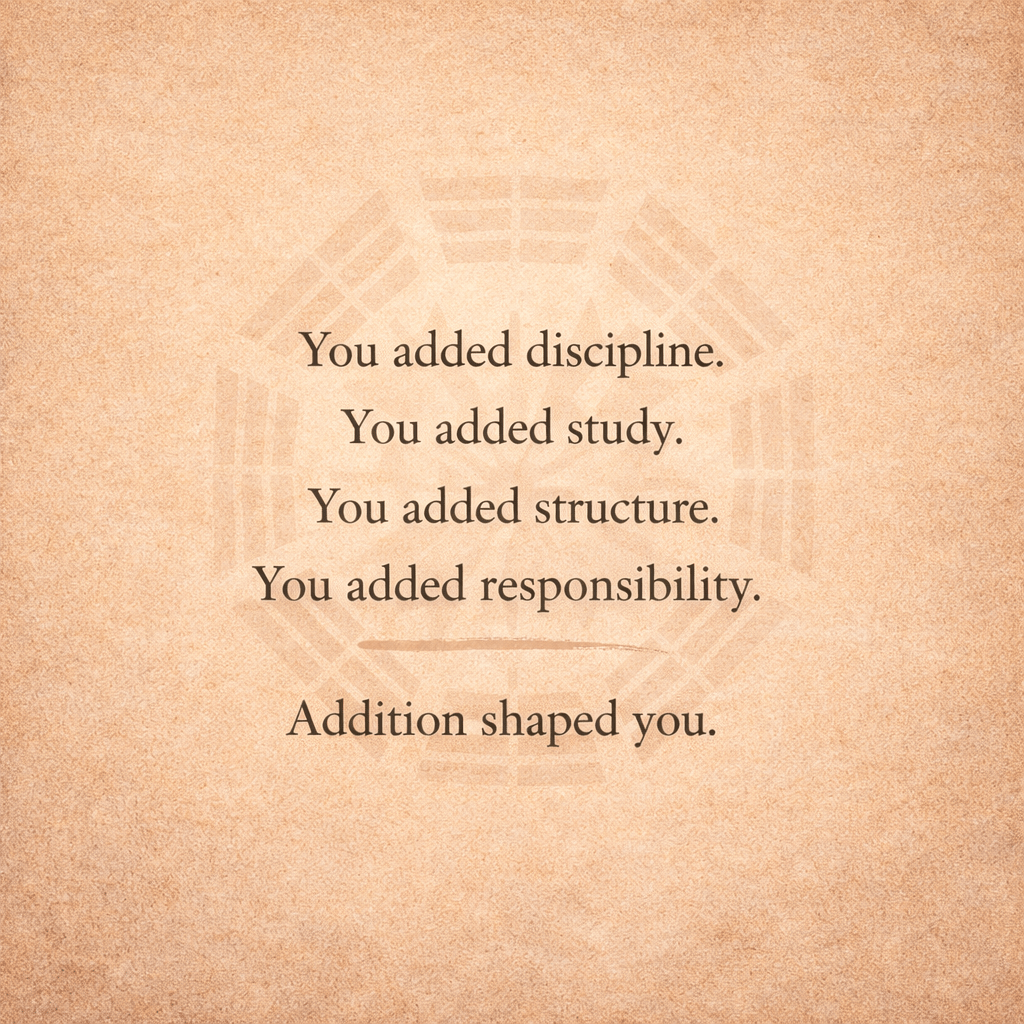
Addition builds a self you can point to. Subtraction asks you to rely on alignment instead of volume. It asks you to stop using quantity of action as proof of worth, and start using coherence as proof of growth. It asks you to choose what matters most, then let the rest become optional—because when everything becomes mandatory, nothing stays sacred. Optional space protects the sacred. Optional space concentrates power.
And that’s why this matters.
At a certain point, growth stops meaning “more.” Growth starts meaning “cleaner.” More precise. More aligned. More honest. A life can expand and still lose spaciousness, the way a room can fill with beautiful furniture until you can’t breathe inside it. Subtraction opens the floor again. Subtraction restores air. Subtraction returns you to the point of practice in the first place: not performance, not perfection, not proving—but presence.
So if you’ve lived in addition for years—and you have—then you’ve already earned the next lesson: you don’t have to complete everything in a day. You don’t have to fire every ritual to feel legitimate. You don’t have to fill the day up so much that there’s no space for peace, calm, insight, joy, laughter, and rest.
You don’t have to finish everything.
You only have to remain aligned.
Make space.
Let something enter.
Stay inspired and inspirational.
— Sifu Khonsura Wilson

 Musings on Martial Arts, Taoist Philosophy & All Things Wellness Related.