
My morning opened without argument, light sliding across the floor in long bands, warming the edge of the mat, catching the lip of the teacup, and coaxing my attention toward the one object that never asks for hype—an old book resting where I left it, waiting with the patience of paper and practice. I poured tea first, watching steam spiral and thin, listening to the small hush that follows a kettle’s sigh, breathing slower while the house settled around me, and only then, choosing the I Ching with the same care I choose a stance, aligning before advancing.

I held the book in my hands, feeling its lived weight, meeting the softened corners, seeing pencil notes tucked into the margins like footprints in dried mud, and noticing a date that carried its own quiet weather—August 18th, 2019—reminding me that time keeps moving, seasons keep turning, and yet the page keeps offering itself, unchanged in availability, unbothered by my delays. Coins waited in my palm, clicking lightly as I shifted them, metal meeting skin, intention meeting chance, and then I cast, letting the small clatter settle into stillness.

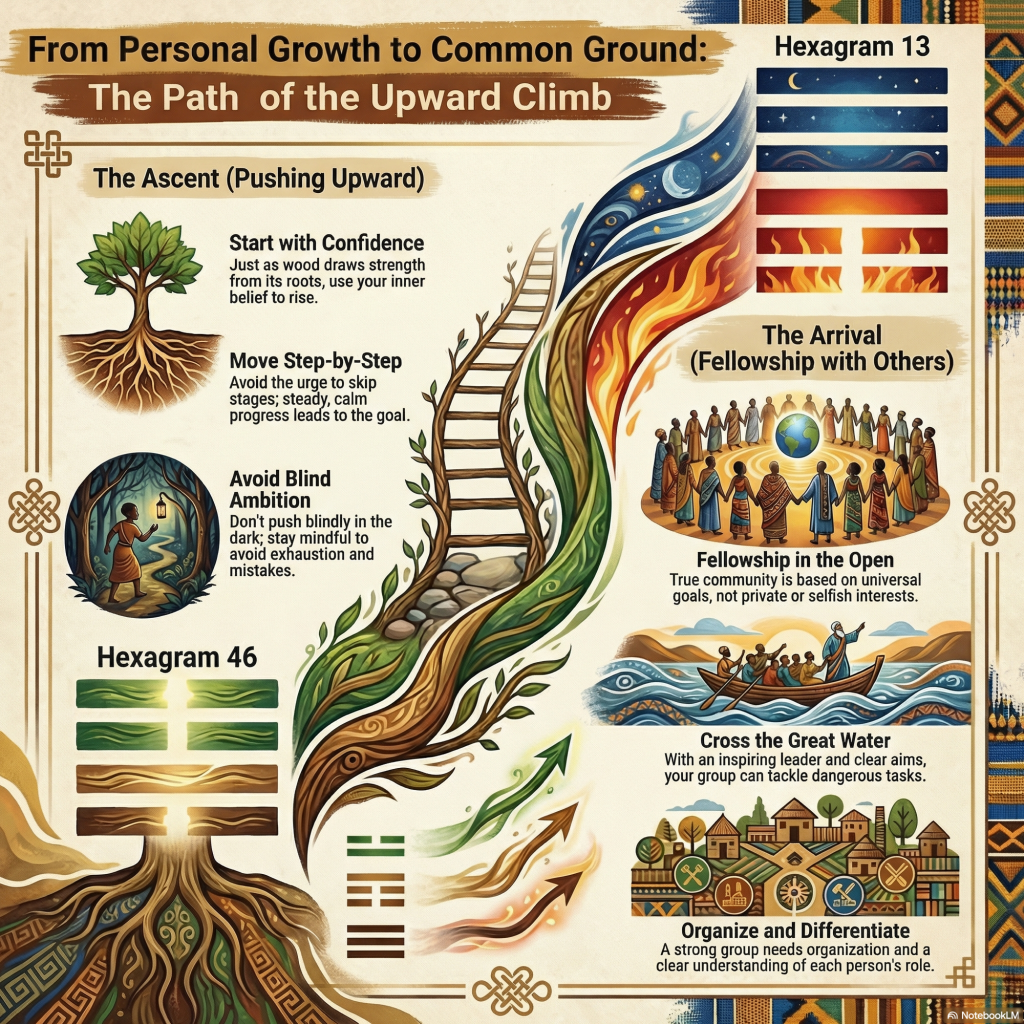
Xíng—Pushing Upward.
Not charging, not crashing, not performing progress for an imaginary audience, but pressing upward the way a tree presses—patiently, persistently, quietly—finding light while finding a way. Brian Walker’s language meets me with that clear-edged kindness I trust, naming a time for progress through effort of will, then tightening the terms immediately, insisting on humility, consciousness, adaptability, and offering an image that teaches without shouting: growth bending around obstacles rather than confronting them, rising steadily while staying gentle.

That tree image carries a soft correction for modern urgency, especially for a culture that loves collision, celebrating “breakthrough” like salvation, praising disruption like virtue, and applauding the loud story of forcing a win, even when the forcing fractures the one doing it. A tree does not argue with stone, does not throw itself at a wall, does not turn a blockage into a personal enemy; it grows, adjusting angle, widening patience, rerouting around what refuses to move, continuing without announcing itself, accumulating height through humble increments, turning time into triumph without turning life into war.
And as I walked that image through my own mind—moving from book to body, from oracle to ordinary—I started noticing the places where pride likes to dress up as “principle,” where impatience likes to masquerade as “drive,” where fear likes to draft its own schedule, keeping me busy with futures that do not yet exist. The hexagram offers a different discipline, a discipline of direction rather than drama, asking for clean motive, clean method, clean relationship to time—innocence, sincerity, balance—three quiet words that can keep a person from chasing a shiny outcome while losing themselves in the chase.

Walker’s reading turns toward relationship too, and I appreciate that turn, because no real life unfolds in solitary splendor, no progress matures without people, without support, without timing, without tolerance. He says I need not fear others now, and he encourages asking for help from those positioned to give it, while warning against the two distortions that wreck dignity—slipping into subservience or surging into forcefulness—then guiding the middle path with a simple posture: meeting everyone with tolerance and gentle goodwill, offering kindness without collapsing, carrying strength without sharpening it into harshness.
Then comes the line that always catches my eye when doubt starts pacing at the edge of attention: when fear or doubt intrudes, remain quietly focused on the activity at hand. That instruction reads almost plain enough to overlook, yet it carries the whole medicine, because fear loves recruiting extra labor, pulling attention into rehearsals, reruns, and imagined interrogations, turning my mind into a committee meeting about outcomes that no one can confirm. The hexagram refuses that second job. It asks for presence as practice, returning again and again to the one honest task, the one real movement, the one immediate responsibility, letting the future arrive later, letting the mind quiet through doing.

And then the changing lines—those small needles of precision—press the teaching into moral shape.
The first changing line points toward confidence, yet not the loud confidence that needs witnesses, not the performative certainty that feeds on attention, but a confidence rooted in relationship with the sage, with guidance that arrives without vanity, moving like breath through the ribs, steadying without strutting. When I trust that inner guidance, I stop posturing. I stop proving. I start proceeding, stepping forward without dragging an ego behind me like luggage.
The second changing line makes the demand firmer: reaching a goal may happen, but character must align with proper principles. That line places ambition in its rightful seat, allowing movement while refusing moral drift, permitting progress while rejecting ugliness as a price of success. I have seen enough to respect that warning, remembering people who “won” and still lost themselves, arriving at the finish line with a hollow face, discovering that achievement without integrity leaves a bitter aftertaste, like sweet tea brewed too long.
And then the sixth changing line closes with restraint, touching the shoulder just before the body lunges: disengage ego and ambition; do not hurl yourself at a closed door; guard inner independence as your most valuable asset. That counsel lands cleanly for me, because a closed door does not always demand courage; sometimes it demands discernment, sometimes it asks for a pivot, sometimes it protects energy, sometimes it points toward a different corridor entirely. A tree does not punch a boulder. It bends, it builds, it continues.

Taken whole, Pushing Upward reads less like motivation and more like calibration, offering progress but insisting on proportion, encouraging effort while discouraging ego, inviting help while preserving dignity, training goodwill while trimming friction. So I asked myself, walking the lesson through the room, letting it touch the day’s ordinary edges: what does upward movement look like when I refuse force?
It looks like completing one sincere task with full attention, moving through it while letting the mind settle, resisting the urge to dramatize the workload. It looks like stretching without testing pride, breathing through tightness, honoring joints, choosing longevity over performance. It looks like preparing steadily rather than panicking, communicating clearly rather than snapping, meeting people with calm goodwill rather than carrying conflict like a trophy. It looks like bending around irritations, redirecting energy, preserving power for what actually matters.

And in that way—by moving without straining, by growing without gritting—this hexagram offers me something better than a bargain for peace: it offers orientation through attention, progress through proportion, steadiness through sincerity, and a way to keep climbing without losing myself.
I closed the book gently, letting the morning keep moving, letting the lesson keep working.
Stay inspired and inspirational.
— Sifu Khonsura Wilson
Reference
Walker, B. (1992). The I Ching or Book of Changes: A guide to life’s turning points. St. Martin’s Press.

 Musings on Martial Arts, Taoist Philosophy & All Things Wellness Related.