The Tao Te Ching didn’t open for me the first time I read it. Not because it felt obscure, but because it felt thin—too simple, almost evasive. I could quote lines easily. I could nod along. Yet nothing stayed. Nothing reorganized me. So I closed the book—not in rejection, but in honesty. I didn’t need more lines. I needed more life.
Years later—after training bodies instead of theories, after teaching people instead of ideas, after failing publicly, aging quietly, and learning restraint the expensive way—I returned. The text hadn’t changed. I had.
What once read like poetry now read like instruction. What once floated now resisted. Certain passages no longer offered insight; they corrected posture. Not metaphorical posture—actual posture. How I stood in conversations. How I approached effort. How I stopped trying to force clarity and started letting it arrive. The Tao wasn’t trying to inspire me. It was checking my alignment.
The I-Ching followed the same arc. Early on, it felt ceremonial and remote—coins, hexagrams, archaic phrasing that seemed better suited to scholars or mystics than to daily decisions. At that stage of my life, I wanted answers that moved fast. The I-Ching moved in cycles.
Only later—after enough repetitions to recognize patterns, reversals, ceilings, and returns—did the text begin to speak plainly. What once sounded mystical started sounding diagnostic. Less “What should I do?” and more “This already happened—here’s where you stand inside it.”
That’s when the pattern clarified:
Some books don’t reward intelligence. They reward readiness.
Dense or ancient language often hides practical wisdom, not because the author wanted to sound elevated, but because certain truths cannot land until life supplies the missing context. When that context finally arrives, something subtle happens: the ideas simplify. You find yourself explaining them clearly, even casually, because you no longer defend them—you recognize them.
The irony stays sharp.
What once felt inaccessible now feels obvious.
What once felt symbolic now feels operational.
And that’s usually the signal.
If a book frustrates you, that doesn’t mean it failed. It may mean the timing missed. Closing it can mark respect, not defeat. The work lies in living long enough, training deeply enough, and paying attention closely enough to become the reader the book waited for.
No gimmicks.
No shortcuts.
Just return, timing, and the slow credibility of lived experience.
Some books don’t teach you. They watch you grow—then speak.
The speech came on last night while I stood there listening, not yet braced for reaction or rebuttal, just letting the cadence occupy the room the way authority often does when it wants to feel unquestioned, carried on a steady voice, deliberate pauses, and emphases arranged to signal control before substance ever has to earn it.
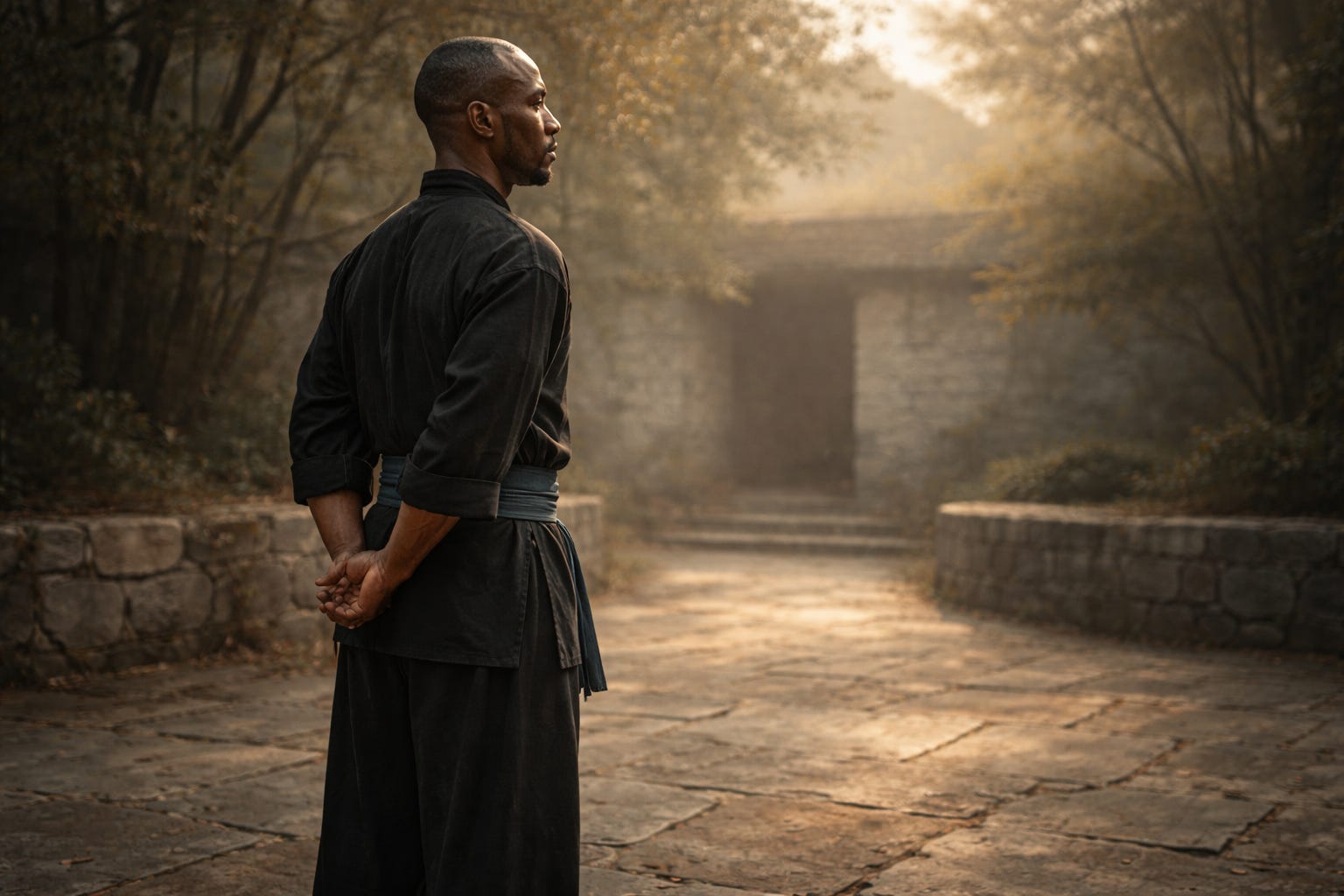
I didn’t sit down. I stayed standing, the way the body sometimes does when it senses that something deserves attention even if the mind hasn’t decided why. As the speech unfolded, I noticed myself lean forward slightly, not from interest or agreement, but from a kind of alert discomfort—the feeling that arrives when something sounds forceful without feeling settled.
“When strength keeps announcing itself, it rarely settles.”
I stayed quiet and kept listening, long enough for the pattern to begin revealing itself. Somewhere in the middle of it, not at an applause line or a promise meant to reassure, a memory surfaced without effort: a passage from the Dao I had read recently, returning not as commentary or critique, but as a measure that already knew how to name what I was sensing. The words came back whole:
One who stands on tiptoe cannot stand long.
One who strides cannot walk steadily.
One who displays himself does not shine.
One who justifies himself has no glory.One who boasts has no merit.
One who parades success does not endure.
-Dao De Jing, Chapter 24
“The Dao doesn’t argue with leadership; it tracks posture and waits for consequence.”
What struck me wasn’t the sharpness of the lines as commentary, but their indifference to argument. The Dao doesn’t oppose leadership like this. It doesn’t interrogate motives or speculate about intent. It tracks posture over time, effort in relation to endurance, assertion weighed against grounding, and then waits for consequence to speak.
As the speech continued, that contrast sharpened. The more insistently strength announced itself, the less weight it seemed to carry. Explanation appeared where steadiness might have sufficed, repetition where authority should have rested. The words moved forward quickly, urgent, amplified, yet nothing arrived with enough balance to stay. I didn’t hear command so much as expenditure—energy spent maintaining an image rather than holding a center.
“In a political age like this one, strain often passes for resolve as long as the delivery stays confident.”
The Dao names this condition without insult, calling it unwanted food, extraneous growth, not as a moral judgment but as a diagnosis of inefficiency. Excess effort doesn’t fail because it lacks intention; it fails because it burns resources without increasing stability. That recognition unsettled me more than disagreement ever could, especially in a tubulent political age like this one, where leadership so often confuses motion for direction, urgency for necessity, propaganda for truth, and visibility for legitimacy. Strain passes for resolve as long as the delivery stays confident and the lights remain on.
What troubled me about the speech didn’t depend on ideology or policy. It registered earlier than that, at the level of bearing. Leadership leaning forward too far, rising onto its toes, spending energy to look strong and competent instead of conserving it to remain steady.
“Leadership reveals itself first through balance, not language.”
The Dao never dramatizes collapse. It predicts exhaustion. It doesn’t moralize failure, it records physics. Any stance held in imbalance long enough begins to hollow itself out, no matter how disciplined the messaging or how often strength gets declared aloud.
Standing there, listening, I didn’t experience the passage as ancient wisdom retrofitted to the moment. It arrived in real time, giving language to something my body had already noticed before my mind rushed in to rationalize it away. Moreover, it didn’t tell me what to think about the speechit clarified why it felt unsettling. So I didn’t argue with what I heard, and I didn’t rush toward a conclusion sharp enough to feel satisfying. I stayed with the recognition, paying attention to posturing instead of promises, listening for strain instead of slogans, remembering that leadership, like stance, reveals itself first through balance rather than language.
“Time asks less about intention and more about endurance.”
Time will do what it always does asking less about intention and more about endurance, less about volume and more about weight, less about how often strength gets named and more about whether it can rest without collapsing.
For now, that orientation feels sufficient. I don’t need a verdict yet, or certainty honed into opinion. I only need to keep my footing clean—to notice when something settles and when it keeps straining upward, and to trust that the body recognizes imbalance before loyalty tries to explain it away.
So I leave the speech where it is, and I carry the measure with me.
If you find yourself listening this week—at a podium, a screen, a meeting table—pause. Before agreement or outrage takes over notice the posturing. Notice how much effort goes into appearing strong and competent. Notice whether anything rests. Stand there a moment longer than usual. That’s often where the illusion falls and clarity arrives.
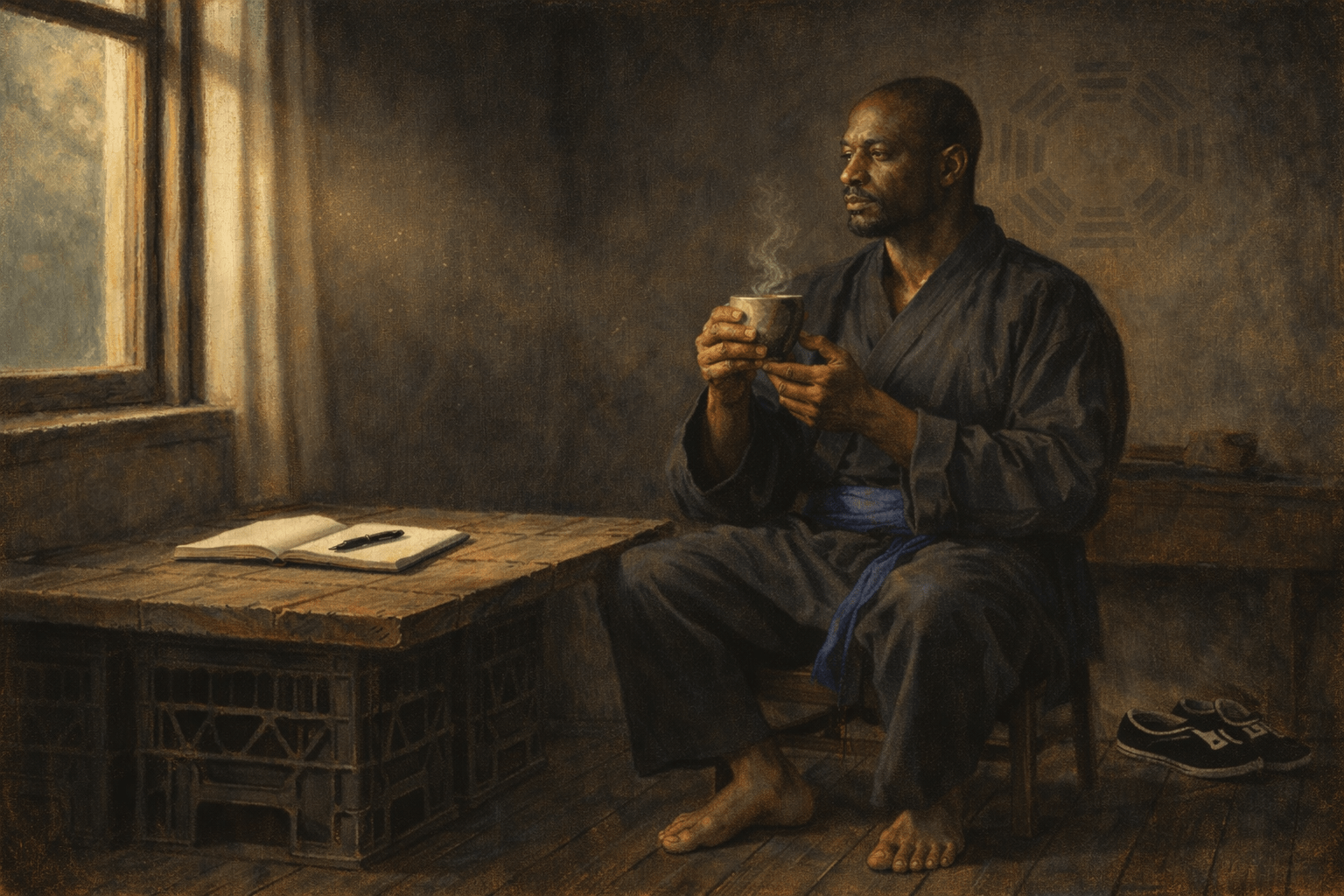
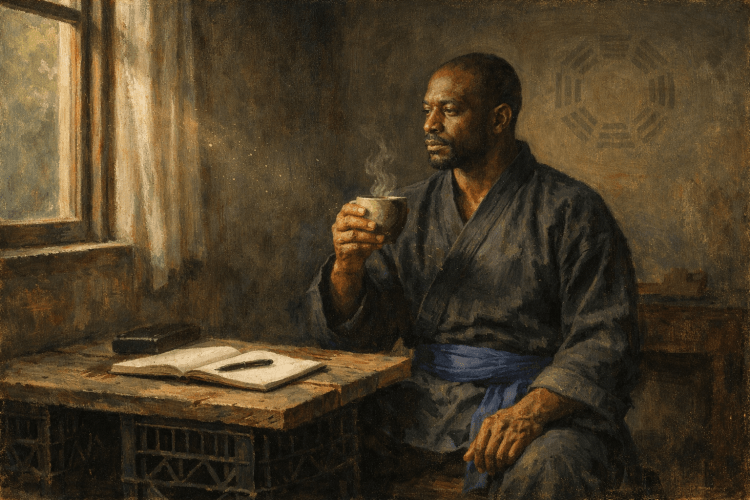
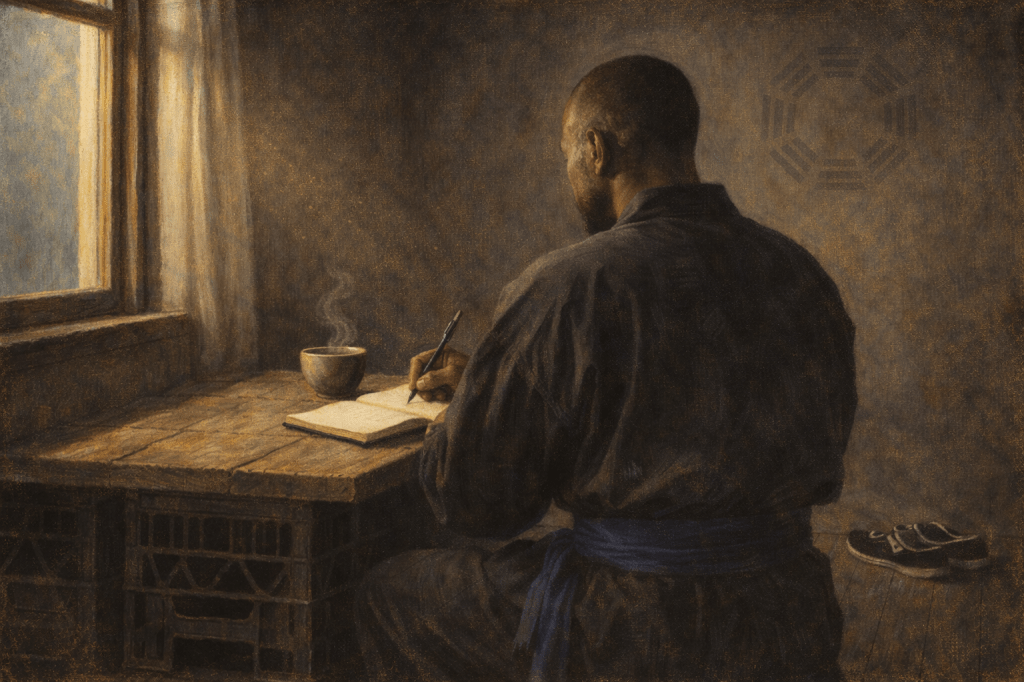
I sat down to write, warm green tea in my hand, at my desk—a rustic door balanced on plastic milk crates—near the window, sunlight pressing against my face, the room holding still long enough for attention to gather without hurry. Nothing in that moment asked for interpretation. The tea steamed. The desk held. The light leaned in. I noticed all of it without effort, without the sense that anything important waited to happen next.
While I sat there, doing nothing in particular and allowing that to count, Dan Millman’s line drifted back—the one from The Peaceful Warrior: ‘There are no ordinary moments.’—a sentence that once snapped my attention into place, the kind of phrase that sharpens awareness and leaves the mind feeling briefly cleaner than it did a moment earlier.
In the story, the sentence doesn’t arrive as a flash of insight. Dan spends the day circling Socrates, offering answers that sound thoughtful, even polished, each one brushed aside without ceremony. He watches the hours move. He feels irritation rise. He wants acknowledgment, some signal that he stands on the right track. Instead, he meets refusal after refusal, casual dismissals that drain the pleasure from cleverness and expose the effort underneath. Fatigue sets in. Attention wavers. The pressure to produce something “right” begins to feel heavier than the questions themselves.
Only after that long stretch of rejection—after wit exhausts itself and performance loses appeal—does the line finally surface, not as a flourish, but as a simple observation drawn from sustained attention rather than inspiration. Socrates accepts it not because it sounds profound, but because it reflects presence earned through waiting, discomfort, and the slow surrender of ego.
That context matters. The sentence carries force because it interrupts habit, disrupts distraction, and insists that attention counts, not as an idea, but as a practice paid for with time and irritation rather than insight alone. Yet, nothing about the moment unfolding in front of me resisted ordinariness.
Life contains many ordinary moments, but nothing breaks because of that.
My awareness stayed present, attention held steady, and breath moved on its own, a moment that registered as plain, unremarkable, ordinary—without lack and without any need for rescue. That distinction carries weight.
Life fills itself with ordinary moments not through accident, but through necessity—moments that repeat, that pass quietly, that don’t ask to feel meaningful while they happen. These moments create continuity, giving the nervous system something steady to lean into, shaping days sturdy enough to hold whatever eventually interrupts them. On the other hand, extraordinary moments serve a different role. They don’t replace the ordinary. They depend on it, arriving as breaks in pattern and moments of contrast that register only because so much came before without calling attention to itself. Without repetition, disruption loses scale. Without rhythm, revelation loses clarity.
For me, this explains why ‘there are no ordinary moments‘ often lands powerfully early on. The line functions like an alarm, jolting attention, shaking the mind out of drift. But alarms don’t build houses. They wake you up, then leave you to figure out how to live there once awareness returns.
Over time, slogans like this lose thickness, not because they deceive, but because they simplify. Growth revises what inspiration once carried, trading uplift for accuracy, replacing insistence with understanding.
A quieter truth holds longer:
Ordinary moments carry life. Extraordinary moments give life meaning.
Meaning needs something to ride on. The body understands this long before language catches up. Ordinariness, on the other hand, often arrives in the body as neutrality, sometimes as boredom, sometimes as mild resistance—the sense that nothing special happens, that effort produces no visible return. Muscles learn through repetition rather than insight. Breath adjusts through exposure rather than realization. Posture improves through small corrections repeated often enough to settle, changes too gradual to notice while they occur.
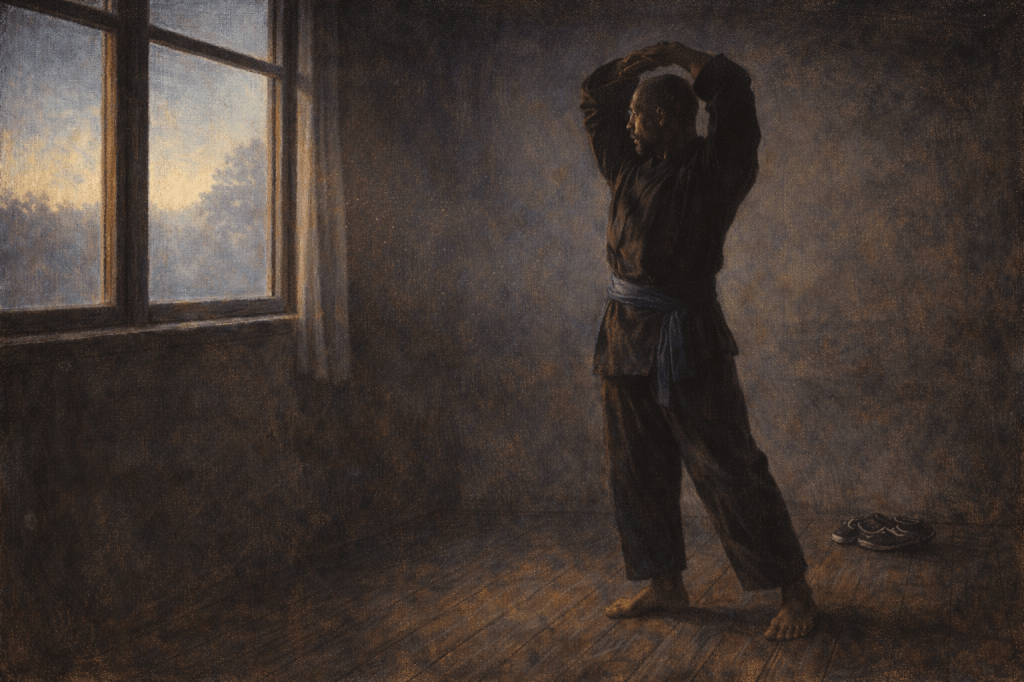
Most days announce nothing. The body simply cooperates a little more, tightens a little less, and recovers a little faster. These shifts hide inside accumulation, revealing themselves later, sometimes much later, when ease appears without a clear origin. Ordinary moments teach the body how to remain. Martial training makes this pattern impossible to miss. Most sessions feel plain: stance again, step again, form repeated without revelation. Progress hides inside routine. Breakthroughs appear rarely and briefly, often after long stretches where nothing seems to change. Plateaus outlast peaks. Corrections arrive delayed, subtle, sometimes invisible to the person doing the work.
Without thousands of uncelebrated repetitions, clarity never arrives—and when clarity does arrive, it never stays for free. Skill depends on what practice stores. Ease depends on what training sustains. Mastery grows out of maintenance. The ordinary carries the extraordinary the way roots carry branches—out of sight, unthanked, doing the work quietly. Time has always known this.
Without repetition, disruption loses scale. Without rhythm, revelation loses clarity.
Long before insight turned into slogans, people learned through living. Builders laid stone knowing the weather would test it for decades. Scribes copied texts, knowing accuracy mattered more than speed. Monastics repeated days not to escape life, but to steady it long enough for understanding to arrive on its own schedule. Endurance taught what interruption never could.
Ordinary moments rarely feel generous while they unfold. They feel like waiting or like time passing without announcement but like nothing in particular. The temptation follows quickly: hurry through, look ahead, treat the ordinary interval as something to endure rather than inhabit. Yet what feels empty while it happens often settles slowly, shaping patience, softening urgency, teaching the mind how to stay without demanding payoff.
The ordinary doesn’t ask for belief so much as participation.
Looking back, clarity rarely gathers around ordinary moments themselves. Memory gravitates toward what disrupts—the argument that shifted something, the insight that arrived unexpectedly, the turning point that refused to stay quiet—while leaving unrecorded the many unremarkable days that prepared the ground, days whose only contribution involved steadiness, repetition, and the absence of drama. Those days don’t announce their value while they unfold, yet they hold everything in place long enough for recognition to happen later, when the pattern finally breaks and something registers as different.
The ordinary doesn’t ask for belief so much as participation. It asks for cooperation rather than conviction, for attention offered without negotiation or reward. When attention learns to stay that way—present without insistence—meaning tends to arrive less like a revelation and more like a settling, fitting itself into place instead of demanding notice. Nothing glows. Nothing announces arrival. Something simply clicks, and the click carries relief rather than excitement. Pressure loosens there. Experience stops asking for interpretation. Continuity resumes its quiet work, doing what it always did, only now without resistance.
If this reflection steadied something in you, let it move alongside an ordinary moment today—drinking tea, tying shoes, training, pausing—not as something secretly meaningful or quietly profound, but simply as what it already counts as, trusting that ordinary time can remain ordinary without loss, and that meaning arrives elsewhere, when contrast finally has something to lean against.







 Musings on Martial Arts, Taoist Philosophy & All Things Wellness Related.