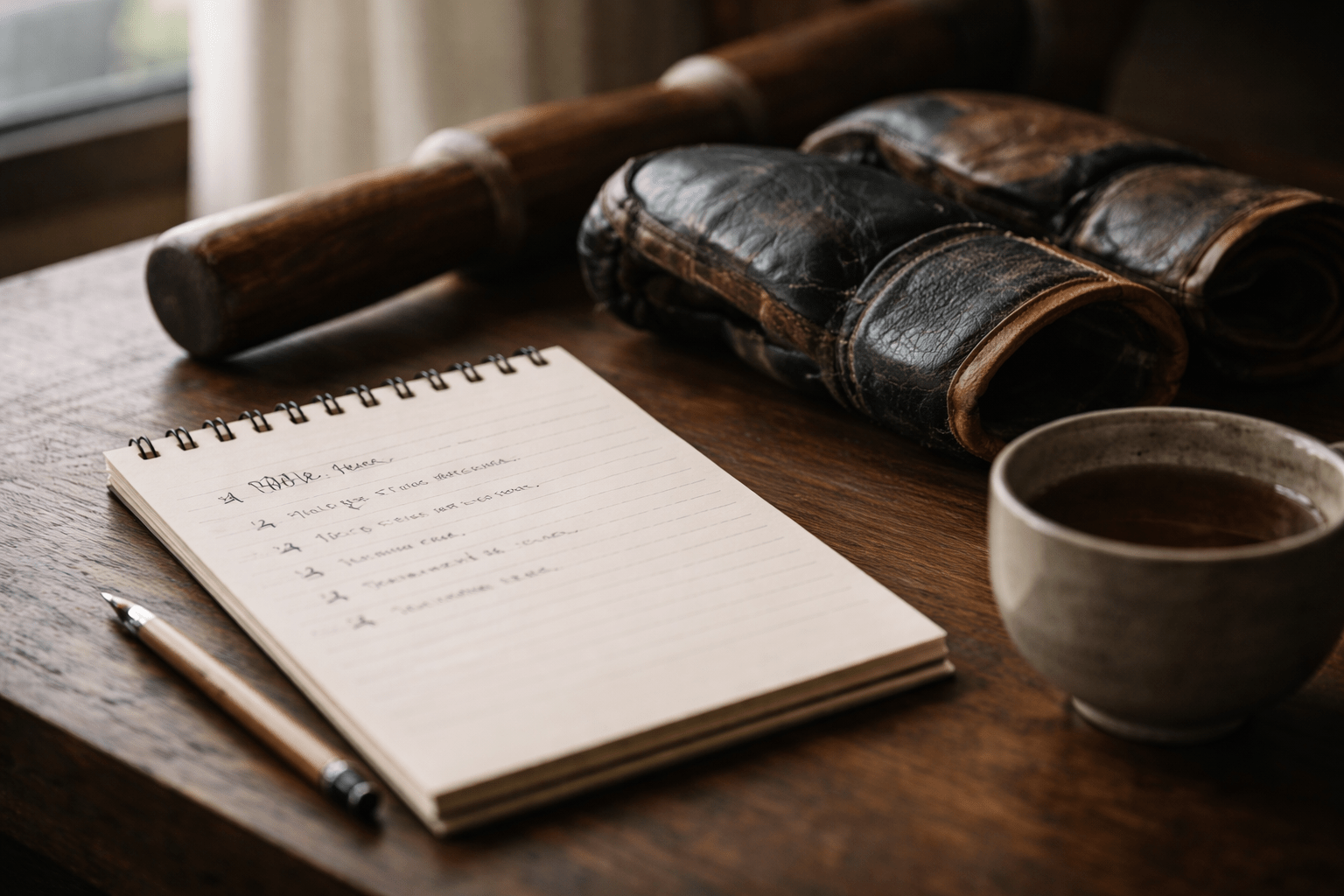
What Keeps Working Rarely Looks Perfect (Laozi, Passage 45)

I thought perfection made things stronger. Laozi reminded me that what keeps working rarely looks perfect. This morning, I tested that idea on my own life.

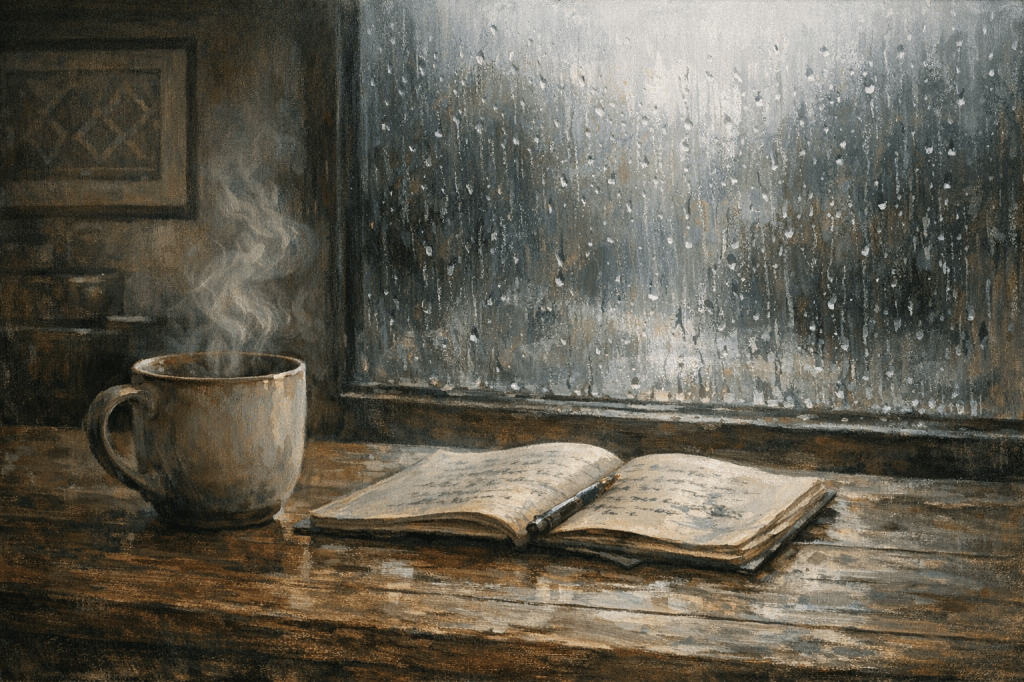
The vanilla-maple candle sweetened my meditation room with that quiet insistence scent always carries—arriving first as warmth in the nose, then as ease in the shoulders, then as a longer, slower breath settling into the body—until the room felt less like a corner of my house and more like a small hermitage where nothing needed to impress and nothing needed to perform. Sitting on the pillow, feeling weight descend through hips and knees, letting the jaw unclench without negotiation and the spine lengthen without strain, I watched my mind try its usual morning trick—reaching ahead, rehearsing tasks, polishing conversations before they occurred—before gently calling it back, not with force but with attention.

I reached for the Tao Te Ching the way I reach for a familiar training tool—handling it without ceremony, opening it without flourish, allowing it to rest in my lap as if the book itself preferred use over display—and turned to Passage 45, pausing long enough for stillness to feel like part of the reading rather than a prelude to it. I did not hunt for a quotable line. I did not squeeze for a takeaway. I let the old voice move through the room.

The greatest perfection seems imperfect, and yet its use remains inexhaustible.

The sentence landed with a quiet rebuke, exposing how often I equate perfection with polish, smoothness, symmetry, finish. I have spent years refining sentences, refining syllabi, refining stances, refining schedules—calling the repetition discipline while sometimes disguising fear. Watching myself revise one time too many, tighten one phrase too carefully, adjust one plan too cautiously, I have learned how easily excellence can tilt into anxiety, how quickly care can become control. Yet living things do not live like glass. Living things live like wood—growing toward light while knotting around wind, bearing scars without forfeiting strength, remaining useful precisely because they have adapted.

So I found myself asking a quieter set of questions, questions that resist performance and reward honesty: Does it still work? Does it still nourish? Does it still return me to center? If the answer remains yes—if the practice steadies breath, if the schedule sustains energy, if the lecture clarifies more than it confuses—then perhaps I stand nearer to inexhaustible power than I thought, power that keeps working even when it does not photograph well.

The greatest fullness seems empty, and yet its use is endless.

Here the passage shifted from polish to capacity, from shine to space. Modern life praises fullness the way a crowd praises noise—full calendars, full inboxes, full commitments, full explanations—yet I have noticed that when I crowd my day too tightly, stuffing it with obligation and ornament, I do not merely lose time; I lose room. The mind becomes a cluttered chamber where nothing new can land, where insight ricochets and leaves. A full cup rejects water. A full week rejects recovery. A full mind resists revision.

Sitting in that candle-sweetened quiet, having allowed breath to lengthen and thought to loosen, I felt the opposite principle at work: emptiness not as absence but as invitation, as open hand rather than clenched fist. By not filling the moment with commentary, by not crowding the morning with productivity, I created capacity; and in that capacity an idea arrived cleanly, rising without strain, entering without force, proving that fullness that looks empty can sustain more than a crowded mind ever could.

The greatest strength looks like crookedness.

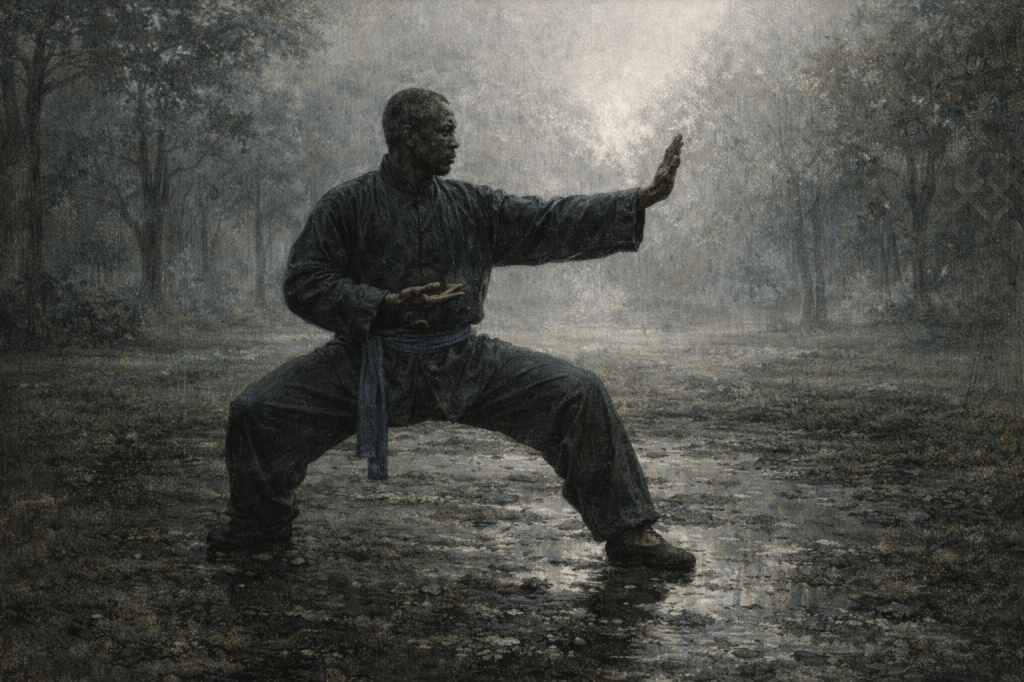
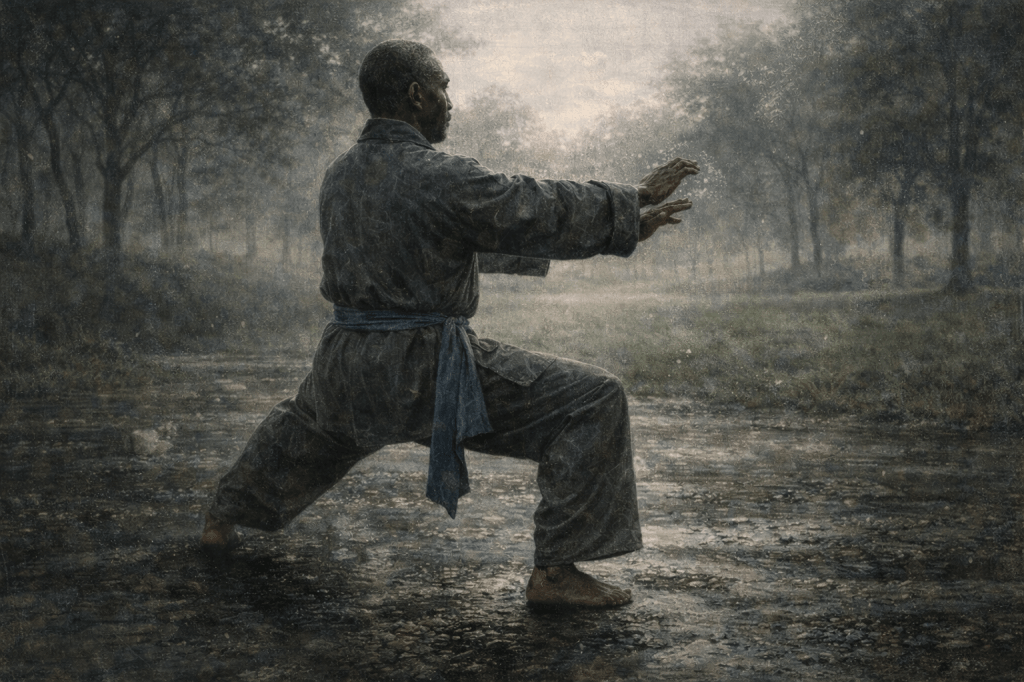
Years of training have taught my body what this line suggests to the mind: stiffness snaps, structure survives. The branch that refuses to bend eventually breaks; the branch that yields keeps its roots. In sparring, durability rarely advances in a straight line; it angles, spirals, sidesteps, conserving energy by refusing ego’s demand for head-on collision. Crookedness, in this sense, signals intelligence rather than weakness, strategy rather than surrender.

So when my own path bends—when a rest week interrupts momentum, when a wandering mind disrupts meditation, when a slower day unsettles ambition—I can choose not to misread the curve as collapse. Bending can preserve continuity. Yielding can protect return. What looks irregular from the outside may, in practice, sustain the long arc of work.
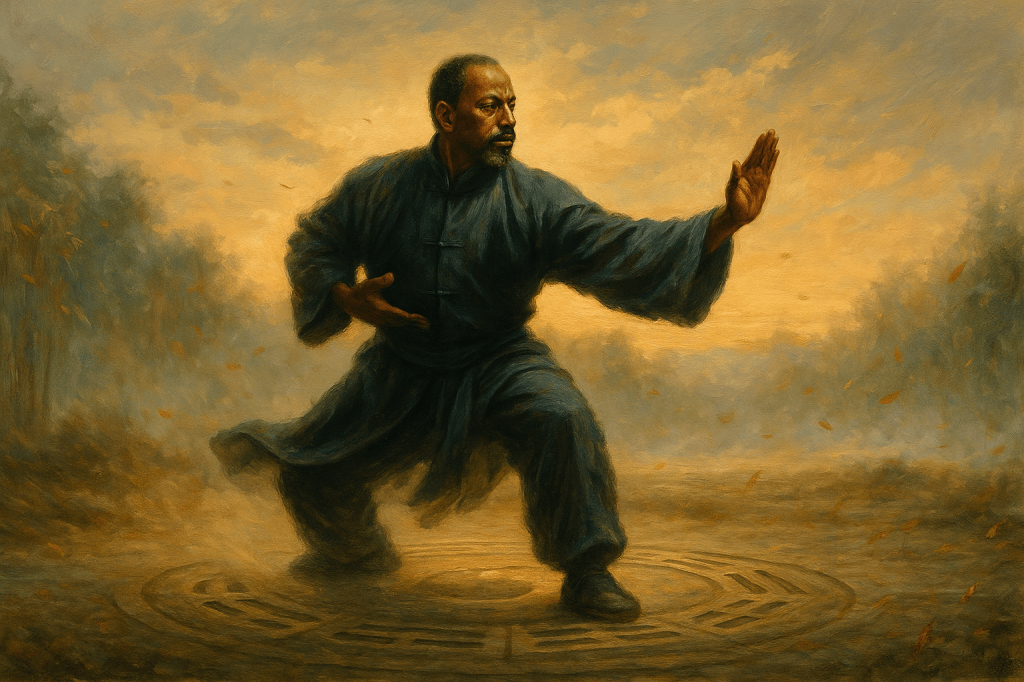
The greatest skill appears clumsy.

This line unsettles a culture addicted to highlight reels and polished performances. I have watched mastery move without spectacle—timing that appears late until it lands precisely, footwork that looks awkward until it closes distance effortlessly, lecture plans that look almost plain until they clarify confusion without fanfare. A true master moves for function—balancing, aligning, adjusting—allowing beauty to emerge as consequence rather than command. In my own creative life, I have seen how often I decorate what only needs to work, adding flourish where structure would suffice, mistaking complexity for depth.

Sometimes the strongest outline looks spare, almost skeletal, carrying only what it must carry, shedding what it does not need. Sometimes the strongest day consists of one clean task completed with care, leaving room for recovery rather than racing toward exhaustion. Plainness can hold power, not because it dazzles, but because it directs.
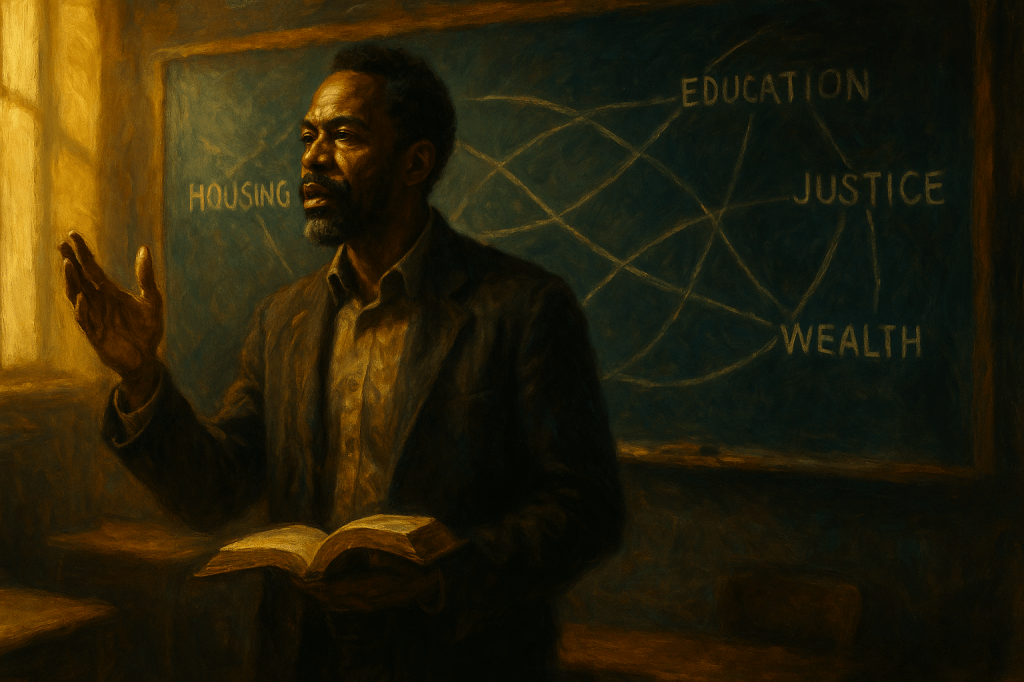
The greatest eloquence sounds like stammering.

As someone who teaches and speaks, I have wrestled with the temptation to sound certain at all costs, to polish cadence until it gleams, to replace pauses with performance. Yet this line suggests another metric: honesty over fluency, alignment over applause. Words that arrive with breath, with searching, with slight hesitation may carry more truth than sentences delivered without a single stumble. Fluency can dazzle and still deceive; pauses can appear awkward and still tell the truth. If I allow breath to remain inside the sentence, if I permit silence to punctuate thought, I preserve humanity within articulation.
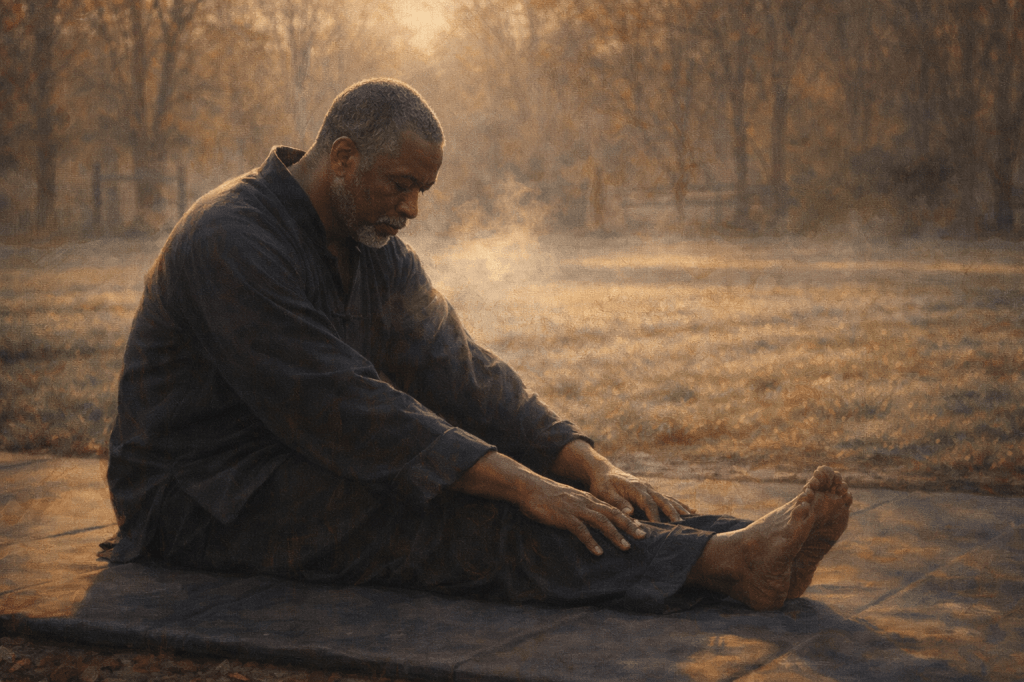
Restlessness overcomes cold, but calm overcomes heat.

Here Laozi offers not abstraction but equipment. Some mornings arrive cold—energy low, will dim, body reluctant—and in those moments restlessness can serve as kindling, nudging motion, stirring circulation, igniting intention. Yet heat—anger, urgency, overload, ambition—does not require more flame; it requires water. Calm cools. Calm restores proportion. Calm reveals the next right step by lowering the temperature of reaction. Learning when to strike a match and when to pour water may constitute a deeper discipline than either constant drive or constant withdrawal.

The peaceful and serene remains the norm of the world.

Storms visit; stillness abides. Noise travels quickly; quiet persists. Reading that final line, I did not hear denial of suffering but orientation toward default. Beneath agitation, beneath overload, beneath the restless churn of ambition, a steadier baseline waits—breath, posture, attention, kindness—available not through conquest but through return. Return, repeated patiently, becomes strength.

At that point I noticed the subtle trap rising in my own thinking, the almost automatic conversion of wisdom into a new standard: I must look calm. I must move perfectly. I must embody serenity without seam. Recognizing the move, feeling the familiar tightening of self-expectation, I chose not to follow it. Instead, I selected something smaller, something workable: I will leave one thing slightly imperfect—on purpose—while keeping it functional, resisting the urge to sand and polish beyond usefulness, allowing the seam to remain visible if the structure still stands.
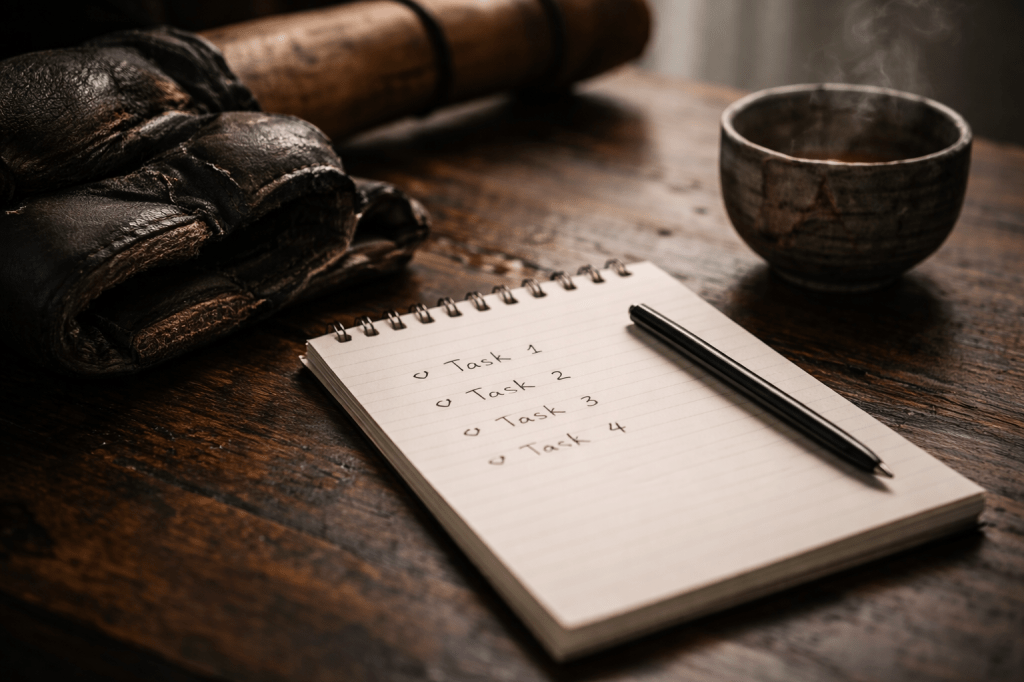
Before the day ends, I will choose a task I normally over-polish, complete it cleanly and competently, and stop—asking whether it works, whether it nourishes, whether it returns me to center, and if the answer holds steady, releasing it without decorative tightening or ego edits.

Then, standing upright, softening my jaw, lowering my shoulders, exhaling longer than I inhale, I will notice one place in my life where I have confused anxiety with excellence, and I will choose, deliberately, to leave that one thing slightly imperfect and fully functional, trusting strength that bends, capacity that empties, and return that steadies.

If any of this sounds familiar—if you recognize the sanding, the stuffing, the straight-line strain—consider where you polish beyond usefulness, where you pack beyond capacity, where you heat what requires cooling. Consider what might shift if you allowed one seam to show while the structure continues to serve.

What will you leave imperfect on purpose—while keeping it functional—so life can keep moving through you?

Stay inspired… and stay inspirational.

— Sifu Khonsura Wilson

Making a Living, Making a Life — What Do You Trade When You Overextend?

⚔️ Rain on the glass. Feet on the path. A question in the ribs.

“I’ve learned that making a living is not the same thing as making a life.”

Maya Angelou

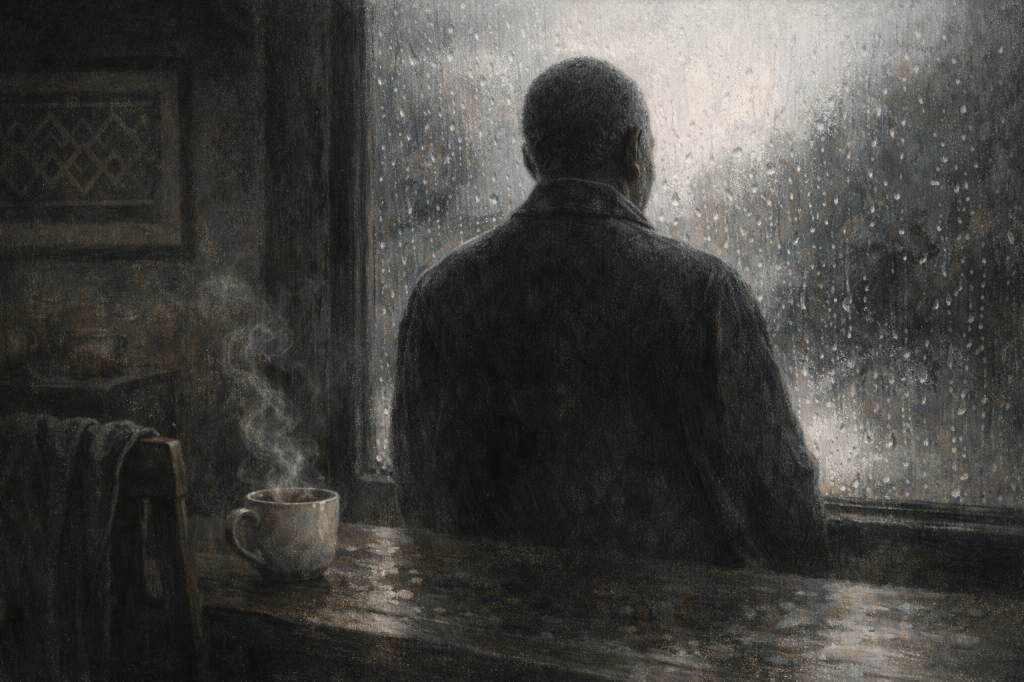
I like to think in motion, because motion refuses the illusion of perfect control, and a long walk turns big ideas into honest measurements—breath, cadence, tension, ease, the small negotiations between desire and limit—so I let the morning set the tempo before I let the mind write the message. Rain stitched itself across the window with soft percussion, and I stood there long enough for the room to narrow and the mind to widen, imagining the walk I would take later—wet sidewalks, hood up, shoulders dropping, attention returning to the simplest instruments: feet, lungs, time. I didn’t want a clean motivational slogan today; I wanted proportion, a standard that could survive a busy week, a heavy schedule, a proud mind, and a body that keeps quiet records.

I noticed a small thing first, the kind of thing a fieldnote catches because it refuses drama: my jaw tightened while the rain kept time, and my shoulders crept up as if the calendar itself had hands, as if the day planned to lift me by the collar. I watched that tension, then I watched the mind try to justify it, and I recognized the old pattern—overextension dressed as responsibility, excess disguised as excellence, strain dressed up in a respectable suit and introduced as “discipline.” I didn’t argue with the feeling. I just recorded it, then I listened for the older voices that always show up when I actually listen.

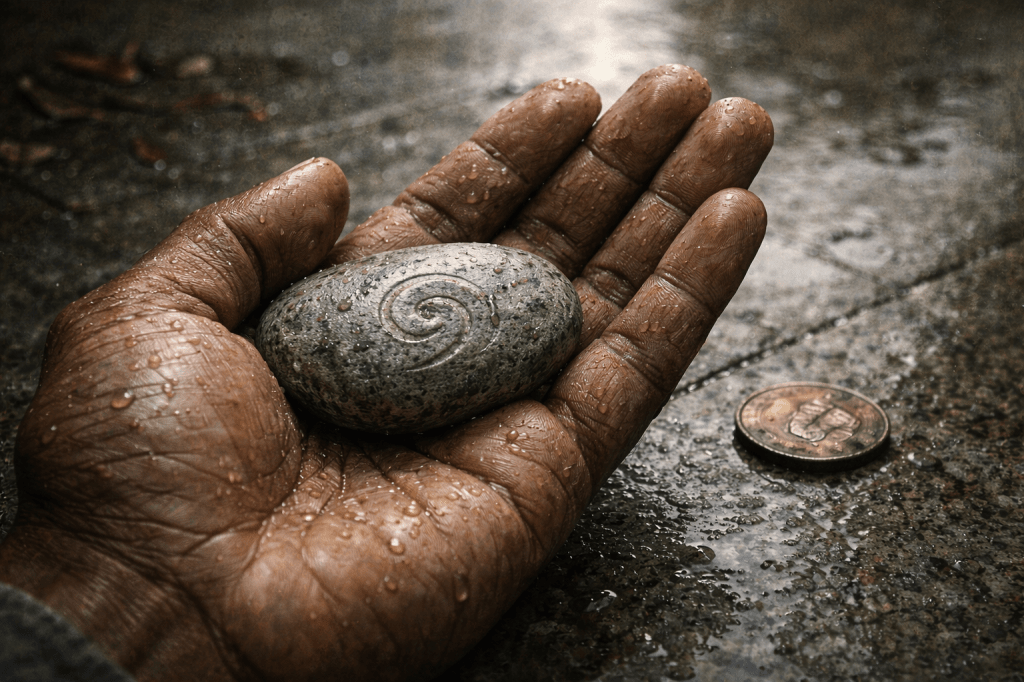
Rain tapped the window this morning with patient insistence, making the room feel smaller while making thought feel louder, and I held two old warnings that arrived from different traditions yet carried the same marrow. One came from the Tao Te Ching, chapter 44, a sequence of questions that presses the reader toward proportion: “As for your name and your body, which is dearer? As for your body and your wealth, which is more to be prized? As for gain and loss, which is more painful?” The other arrived as a crisp I Ching reminder I’ve carried like a pocket-stone: overextension invites decay. Together they formed one sober instruction—neither against ambition nor against desire—yet fully against excess, against the quiet habit of pushing past measure until what once felt like growth begins to feel like erosion. These traditions don’t condemn effort; they warn against the kind of effort that refuses timing, ignores limits, then acts surprised when the body, the mind, or the spirit begins to dry out.

Decay rarely enters like a dramatic collapse. It doesn’t always arrive as injury, burnout, or public disgrace; it often arrives as subtler changes, as increments that seem too small to count until they gather into a pattern you can’t ignore, a pattern you can feel in the ribs before you can explain it in words. Overextension shows up when the schedule stretches beyond breath and breath shortens in response; when training expands beyond recovery and joints begin to whisper; when the mind keeps chasing proof and sleep thins; when the appetite for more—more work, more status, more security, more control—fills the day so completely that the nervous system never fully unclenches. Nothing explodes, yet something dries. Taoist texts notice these small costs precisely because these small costs compound, and the I Ching’s warning about overextension describes the same mechanism: expansion without proportion doesn’t produce endless upward movement; it produces reversal, correction, contraction, and decay.

And I notice how this drying works, how it doesn’t ask permission, how it doesn’t announce itself with sirens, how it just keeps subtracting in small, stealthy sips—one thin night of sleep, one irritated morning, one more cup of coffee, one more skipped stretch, one more day lived in the shoulders—until the body starts speaking in a language the mind can’t keep interrupting. The fieldnote part of me trusts that language. It doesn’t romanticize it. It records it, then it follows the pattern back to the source.

The first Taoist question, “name or body, which is dearer?” doesn’t scold; it clarifies hierarchy. A name carries reputation, legacy, the desire to matter, the hope that others speak of you with respect, and in a world that rewards visible output and public recognition, a name can feel like a form of safety, like a shield you can hold up when the world grows sharp. Yet a name cannot breathe for you, cannot walk for you, cannot sleep for you, cannot stretch the hips that hold the day’s tension, cannot regulate the nervous system after a week of pressure. The body, by contrast, holds every conversation you will ever have, every lesson you will ever teach, every practice you will ever refine, every moment of love you will ever offer. When life forces a trade—when you must choose between appearing invulnerable and remaining healthy, between praise and rest—the Tao quietly recommends choosing the body first, not because reputation lacks value, but because reputation cannot outrank the instrument through which life happens.

I write that and I can feel the resistance that tries to rise in me, the little protest that says, yes, but the name pays bills, the name opens doors, the name protects against disrespect, the name keeps the work moving. I don’t deny any of that. I just notice the deeper ledger that the body keeps, because the body doesn’t accept promotions as payment, and the body doesn’t trade sleep for status without sending an invoice later. So the question doesn’t ask me to stop caring about legacy; it asks me to stop sacrificing the vessel that carries the legacy.

The next question, “body or wealth, which is more to be prized?” extends the same logic into another arena where overextension often hides under the costume of prudence. Wealth can buy tools, reduce inconvenience, open options, grant time, and no honest person needs to pretend that money carries no meaning. Yet money cannot purchase back a nervous system exhausted by chronic strain; money cannot restore joints worn down by pride-driven intensity; money cannot reverse the subtle stiffening that accumulates when rest becomes rare. The Tao’s critique doesn’t demand deprivation; it demands proportion. Excessive accumulation—“the storing of too much goods”—comes with weight: maintenance, attention, complexity, worry, distraction, and that weight drains vitality in slow, silent sips. A person can possess more and live less, not because possessions offend some spiritual law, but because excess burdens the mind and steals time. Overextension often begins here, not in extravagance, but in the quiet habit of adding and adding, storing and storing, until the storing stores the one who stores.

That last line—until the storing stores the one who stores—keeps showing up in life as a plain, unglamorous fact. I see it when a person maintains a life they can’t live inside. I see it when organization becomes obsession. I see it when the tools intended to serve the work become the work, then the work intended to serve the life becomes the cage. The tone doesn’t judge that pattern. It just names it, because naming it reduces its magic.

The third question, “gain or loss, which is more painful?” points toward the emotional engine that drives overextension when the calendar already groans. Gain excites, yet loss haunts, and fear of loss encourages people to push past measure in order to feel safe. The fear whispers that one more achievement, one more purchase, one more commitment, one more late night will secure the future, and the whisper often sounds reasonable because it speaks in the language of responsibility. Yet fear of loss can cost more than loss itself when it hardens into a lifestyle, converting each day into a defensive posture, a small war against imagined scarcity. Overextension becomes a form of insurance, but the premiums get paid in sleep, peace, attention, health, and relationship. Here the I Ching lands with blunt clarity: overextension invites decay. Expansion without timing invites correction; growth without proportion invites contraction; life refuses permanent acceleration.

And that refusal matters, because a person can argue with life for a long time, can bargain, can brace, can push, can perform competence, can stack commitments like bricks, and still life will eventually answer with physics, with fatigue, with friction, with the body’s quiet veto. The fieldnote voice trusts consequences more than promises. It watches the outcome and learns from the outcome. It notices the pattern: constant acceleration doesn’t produce constant ascent; it produces strain, then snapback.

When the Tao warns that “an excessive love for anything will cost you dear in the end,” it doesn’t condemn love; it condemns attachment that hardens into clutching. Excessive love of productivity becomes burnout; excessive love of recognition becomes anxiety; excessive love of youth becomes injury; excessive love of control becomes isolation; excessive love of security becomes hoarding. The phrase “cost you dear” matters, because the cost often arrives in currencies we don’t account for until we spend them—breath, mobility, patience, tenderness, time—then wonder why the account runs low. A person can grow rich in objects and poor in presence. A person can grow admired in public and depleted in private. The Tao doesn’t forbid desire; it disciplines desire so desire stops eating the very life it claims to improve.

I keep returning to that phrase—cost you dear—because it doesn’t threaten hell, it doesn’t wag a finger, it doesn’t preach. It just tells the truth about trade. Every life runs on trade. Every schedule runs on trade. Every “yes” requires a “no” somewhere, even when you don’t say the “no” out loud. And overextension often means you keep paying, paying, paying, then acting surprised when the body hands you the receipt.

This leads to the central prescription: “To know when you have enough is to be immune from disgrace. To know when to stop is to be preserved from peril. Only thus can you endure long.” Enough rarely arrives as a number on a screen or a target on a list; enough often arrives as a felt sense—nervous system settling, mind quieting at night, body moving without constant complaint, spirit releasing resentment toward its own ambition. Stopping, in this view, doesn’t signal weakness; it signals skill, the practiced capacity to preserve what matters. In martial language, stopping at the right time resembles keeping the guard while releasing unnecessary tension; it resembles refusing the overcommitted strike that exposes the ribs; it resembles choosing structure over strain. Overextension in the dojo reveals itself immediately: a stance stretched too far loses root, a punch thrown past range exposes the line, a breath forced beyond rhythm tightens the whole frame. Life works the same way, just slower and less obvious. The person who cannot stop will eventually get stopped by injury, exhaustion, or bitterness; the person who learns when to stop preserves endurance.

I trust that dojo analogy because it refuses abstraction. A body can’t fake range. A body can’t fake root. A body can’t fake breath. You can posture in conversation; you can posture on a résumé; you can posture online; you can’t posture through a misaligned knee under load, and you can’t posture through a nervous system that never settles. So the Tao’s “stop” starts sounding less like moral advice and more like craft—timing, measure, restraint, rhythm, the kind of intelligence you can feel in the feet.

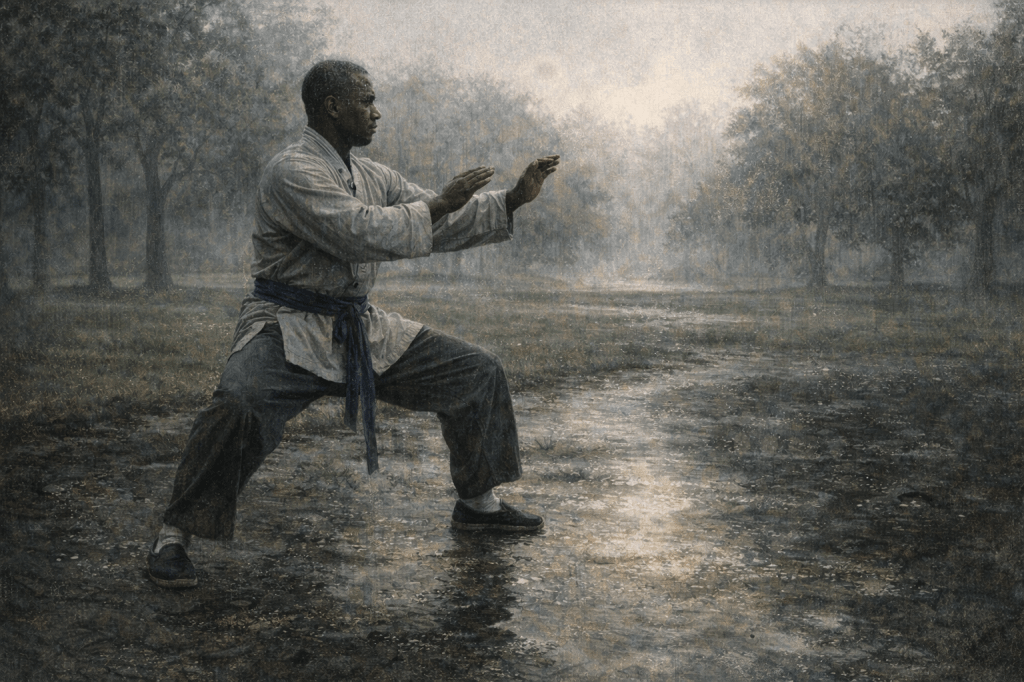
The passage’s line about letting the “flexibility and grace of yoga, tai chi” replace the “power of lifting at the gym” reads best, to my mind, as an invitation to rebalance rather than a command to abandon strength. Strength matters, and grace keeps strength usable. Power matters, and softness keeps power responsive. A martial artist doesn’t need to choose between structure and flow; a martial artist needs both, because structure without flow turns into armor that restricts the wearer, and flow without structure turns into drift. Tai Chi doesn’t remove power; it trains power to arrive without strain. Yoga doesn’t erase resilience; it teaches resilience to live inside length, space, and breath. When we train with attention instead of ego, with alignment instead of aggression, with breath instead of bracing, we practice the very non-resistance the passage recommends. We stop fighting the body we carry today. We stop arguing with time. We cooperate with reality while still cultivating capability.

And I notice how this cooperation changes the feel of effort. Effort can feel like clean work, like skillful strain that ends in recovery, like sweat that doesn’t steal sleep, like practice that leaves the mind clearer rather than harsher. Or effort can feel like friction, like forcing, like proving, like clenching through the day then collapsing at night, like living in the shoulders while calling it dedication. The fieldnote tone keeps returning to sensation because sensation tells the truth faster than ideology.

Consistency remains the challenge, and your admission—that you need reminders—carries humility, and humility keeps the Tao close. The issue doesn’t involve sainthood; the issue involves practice, awareness sharp enough to notice overextension early, before decay deepens. Overextension often disguises itself as virtue: hard work, dedication, preparedness, discipline. Yet virtue without proportion turns brittle, and brittleness cracks. Decay whispers first, not as catastrophe, but as subtle irritation, stiffness, restless sleep, shallow breath, thin patience. The sage adjusts early, not after collapse.

The phrase “overextension invites decay” therefore functions as more than a warning; it functions as a daily diagnostic. Where does extension still serve life, and where does extension quietly erode life? The answer often appears in the nervous system. When expansion feels grounded, it builds; when expansion feels frantic, it erodes. Endurance requires rhythm, not constant intensity. The Tao does not chase spectacle; it cultivates steadiness. Steadiness preserves joints, preserves clarity, preserves relationship, preserves joy. And joy in this older sense doesn’t require constant happiness; joy shows up as a system that can unclench and return, a life that can move with proportion, a practice that can endure.

As rain continued its soft percussion against the window, I felt the familiar tug to push a little further—to add, to refine, to extend—yet the passage lingered like a steady hand on the shoulder. Not yet. Not too much. Just enough. Perhaps that discipline—quiet, unglamorous, deliberate—holds more power than any surge of intensity ever could, because it protects the one thing every other ambition depends on: the capacity to endure long.

And when I finally picture myself outside—water beading on the sleeves, shoes darkening at the edges, breath rising and fading—I can feel how the whole lesson fits a walk better than it fits a lecture, because a walk teaches proportion without argument. A person can’t sprint forever without paying. A person can’t hold the breath forever without shaking. A person can’t keep adding miles, tasks, promises, proofs, without some part of the self filing a quiet complaint. So I keep the older instruction close, not as a scold, not as a ban on ambition, but as a rhythm check—name versus body, body versus wealth, gain versus loss—because the day will ask for everything, and a wise life answers with measure, then keeps walking.

By the time the walk ends, the rain usually softens, not because the sky changes its mind, but because the body changes its relationship to the weather, and I notice that the whole morning’s lesson never asked me to become less driven, only less dragged, less yanked by the anxious need to prove, protect, accumulate, and control. I can earn, I can build, I can train, I can teach, and I can still refuse the old superstition that says exhaustion equals virtue. I can keep the work honest without keeping the life clenched, because the life doesn’t ask for permanent acceleration; it asks for proportion, for rhythm, for enough.

So I try to end the day the way I try to end a good session in the dojo: stepping back into guard, loosening what doesn’t serve, keeping what does, leaving the room with breath still available. If I sense that familiar tug to push a little further—one more task, one more message, one more refinement—I practice the quieter strength instead: I stop on purpose, I stop with skill, I stop while I still can. Then I return to the household life—tea, dishes, dogs, a conversation that doesn’t need performance—carrying the only wealth that multiplies when spent wisely: mobility, clarity, tenderness, time.

And when the mind tries to bargain again, dressing overextension in the language of responsibility, I let chapter 44 ask its three questions one more time, not as philosophy, but as a practical test that fits inside a single breath: name or body, which counts more; body or wealth, which deserves more; gain or loss, which hurts more. The answers don’t demand drama. The answers demand measure. I don’t need to win the day; I need to endure long.

Stay inspired and inspirational.

— Sifu Khonsura Wilson
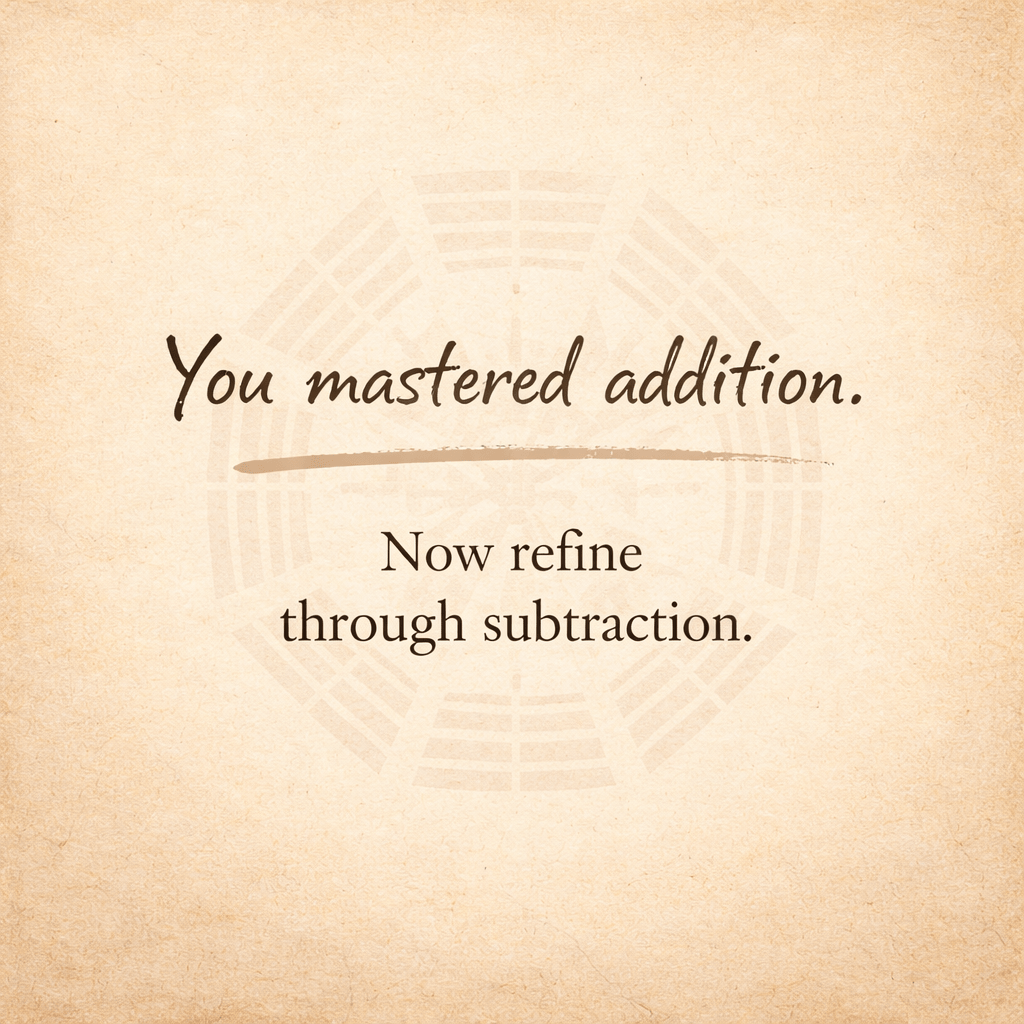
You Mastered Addition but Now The Tao invites Subtraction.

That line doesn’t flatter you. It recognizes a season you already survived, a season where you proved—through repetition, responsibility, and relentless return—that you could build a life with structure, build a body with practice, build a mind with study, build a name with consistency, and build an identity that held steady even when motivation wandered. Addition worked, and it worked for a reason. Early growth usually asks for more: more reps, more pages, more discipline, more refinement, more intentionality, and more willingness to show up when you don’t feel like it. You didn’t just “try.” You stacked days, and those days stacked you back.

But addition carries a quiet shadow.

Accumulation.

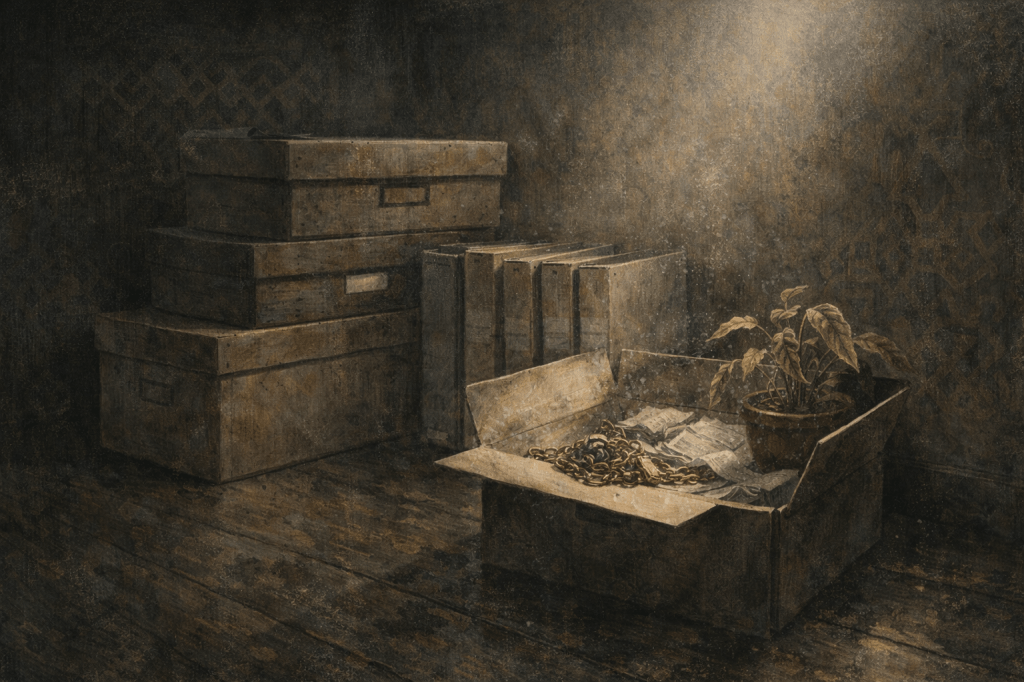
Every good thing that enters your life wants to stay, and when you keep every practice, every ritual, every plan, every “helpful” routine, the day starts to thicken. The schedule tightens. Completion gets crowded. And you can still move efficiently—checking boxes, honoring habits, running the system—while noticing a strange cost: the loss of permeability. You begin to feel like you live inside your own checklist, like you built a house of discipline and then forgot to leave windows open.

That’s where the Taoist pivot lands with surgical precision: when every minute gets accounted for, nothing new can enter. Insight needs margin. Creativity needs pause. The nervous system needs unstructured time to digest experience, to integrate emotion, to consolidate learning, to let wisdom settle rather than merely pass through. When the calendar absorbs every available inch of space, you can produce a lot and still feel inwardly tight, because you never left room for the unexpected gift—laughter that arrives unplanned, peace that drops in softly, a new thought that needs silence to form, a small joy that slips through only when you stop guarding the gate.

So Tao invites subtraction.

Not regression. Refinement.

In art, subtraction clarifies form. A sculptor doesn’t add marble to find the figure; the sculptor removes what doesn’t belong. A writer doesn’t always improve a paragraph by adding sentences; the writer sharpens meaning by cutting what muddies the point. A musician makes the notes hit harder by respecting the rests. In every case, subtraction doesn’t weaken the work; it defines it, it reveals it, it gives it shape and breathing room. The same principle holds in your training and in your daily life: tension slows the body, and release restores speed; over-activation scrambles the mind, and pause restores clarity.

Subtraction, in your context, means asking a more mature set of questions.

What is essential, and what is ornamental? What actually strengthens me, and what simply reassures me? What sustains my identity, and what props it up because I don’t trust myself yet? Because that’s the real test hiding underneath “do I have time?” The deeper question asks, “Do I trust myself enough to leave something undone without feeling like I failed?”

That question takes more courage than addition ever did.

Addition builds a self you can point to. Subtraction asks you to rely on alignment instead of volume. It asks you to stop using quantity of action as proof of worth, and start using coherence as proof of growth. It asks you to choose what matters most, then let the rest become optional—because when everything becomes mandatory, nothing stays sacred. Optional space protects the sacred. Optional space concentrates power.

And that’s why this matters.

At a certain point, growth stops meaning “more.” Growth starts meaning “cleaner.” More precise. More aligned. More honest. A life can expand and still lose spaciousness, the way a room can fill with beautiful furniture until you can’t breathe inside it. Subtraction opens the floor again. Subtraction restores air. Subtraction returns you to the point of practice in the first place: not performance, not perfection, not proving—but presence.

So if you’ve lived in addition for years—and you have—then you’ve already earned the next lesson: you don’t have to complete everything in a day. You don’t have to fire every ritual to feel legitimate. You don’t have to fill the day up so much that there’s no space for peace, calm, insight, joy, laughter, and rest.

You don’t have to finish everything.

You only have to remain aligned.

Make space.

Let something enter.

Stay inspired and inspirational.

— Sifu Khonsura Wilson