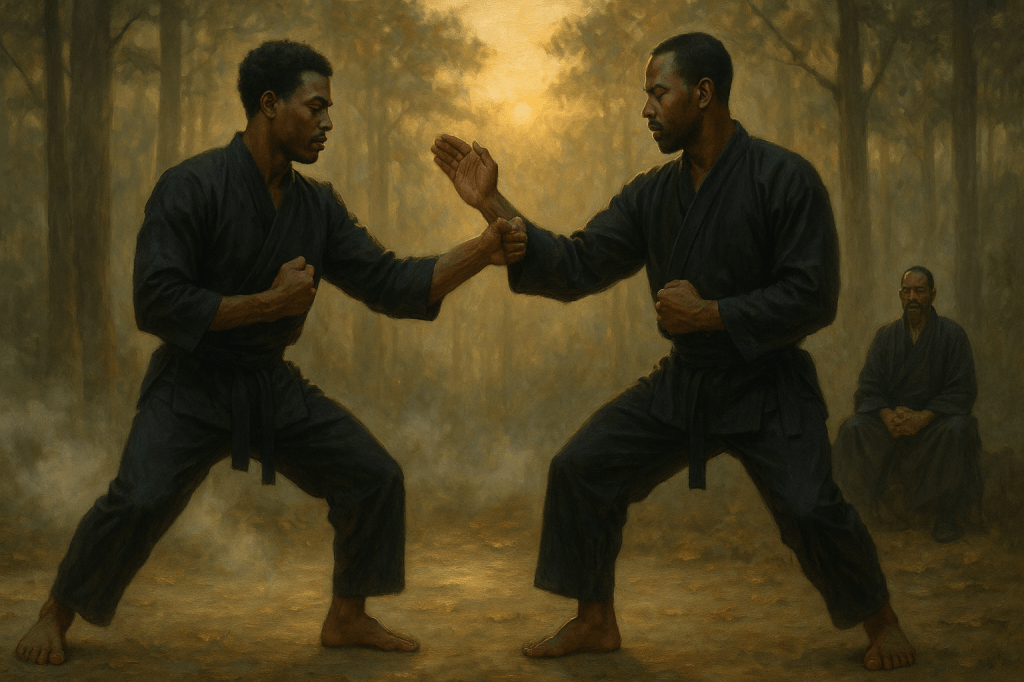
Stretching Isn’t What We Were Taught — And That’s a Relief

I didn’t come to stretching through science, charts, or protocols neatly stacked in someone else’s certainty. I came to it through stiffness, through those mornings when the body speaks before the mind has finished waking, through that familiar pause after training when you rise from the floor and something in the hips or lower back hesitates—not injured, not broken, just unwilling to move on command. Stretching entered my life the way most lessons do: as a response, not a choice, a way of negotiating with sensation when effort alone stopped working.
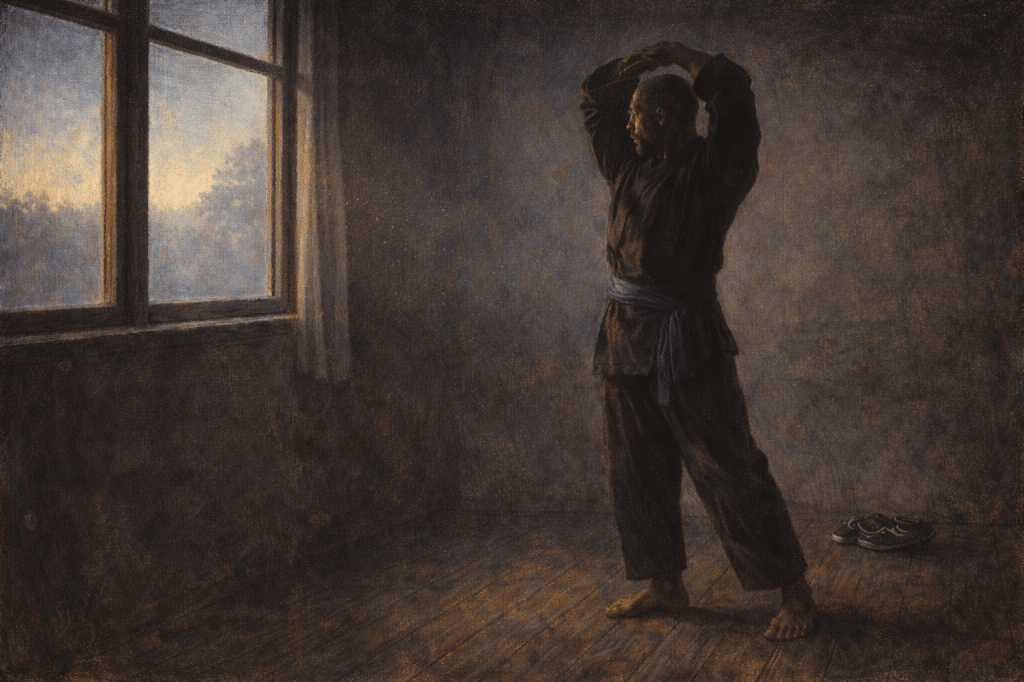
For a long time, I stretched because that’s what responsible practitioners were supposed to do. Teachers said so. Training manuals implied it. Soreness followed effort so reliably that stretching felt like the proper closing ritual, the bow at the end of work. It carried a quiet moral weight too, as if stretching proved I wasn’t exploiting the body, that I knew how to care for what I demanded from it. And to be fair, stretching did something. It slowed the breath, softened sensation, drew attention inward after the outward push of training. It created a pause where the system could settle, where striving loosened its grip. But it didn’t do what I thought it was doing.
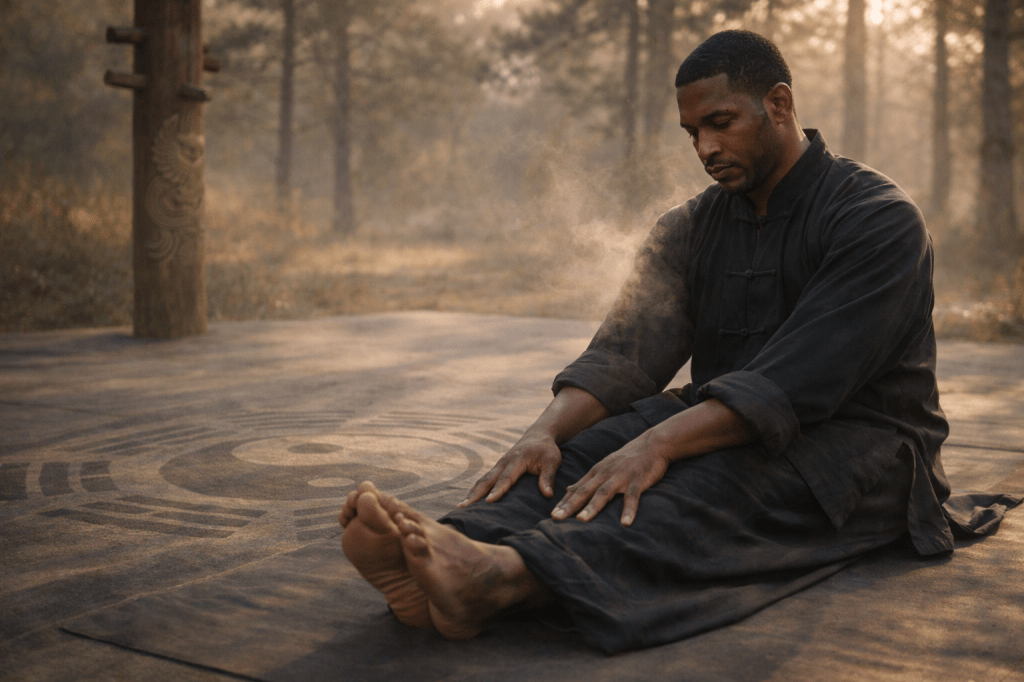
There were mornings when I felt physically shorter than the day before. Same bones, same joints, same body stepping into the light, yet the range felt reduced, the hips less cooperative, the spine guarded. My instinct used to be frustration. I trained yesterday—why do I feel worse today? That frustration usually led to more stretching, longer holds, deeper pulls, leaning into sensation as if discomfort itself held the answer.

Over time, though, a pattern emerged that refused to bend to that logic. On the days following heavy work—deep stances, long holds, sessions that asked a lot from the legs and core—the range hadn’t disappeared. It had withdrawn. The body wasn’t resisting flexibility; it was conserving integrity. What felt like tightness wasn’t failure. It was timing.
That which is forced invites resistance; that which is allowed returns on its own.”

Tao Te Ching

Standing there on those mornings, I began to feel the truth of that—not as philosophy, but as physiology. Once that settled in, something softened in me. Stiffness stopped reading like a flaw and started reading like information. The body wasn’t saying no; it was saying not yet.

Around that same season of noticing, science caught up with what experience had been whispering. Stretching doesn’t meaningfully reduce post-exercise soreness. The soreness most people mean—Delayed Onset Muscle Soreness, the ache that shows up a day or two after unfamiliar or intense effort—barely changes with stretching at all. Once that’s understood, it becomes easier to stop blaming yourself when DOMS appears. It isn’t punishment. It’s adaptation doing its work.

And the old story about flushing out lactic acid turns out to be misplaced blame. Lactate isn’t waste; it’s fuel, and the body clears it on its own if you simply let circulation do its work. That realization didn’t disappoint me. It relieved me. It meant recovery didn’t need to be earned through discomfort. Muscles adapt on their own schedule. Healing unfolds when conditions allow it, not when we argue with it. Stretching wasn’t cleaning anything up. It was doing something quieter. It was signaling the system that the demand phase had ended, that effort could give way to restoration.
“Knowing when to stop preserves what sustains you.”

Tao Te Ching

There’s a particular dullness that follows long static stretching before explosive effort. Anyone who has sprinted, jumped, struck, or lifted after extended holds knows the feeling even if they’ve never named it. The movement still happens, but without urgency. Power arrives muted, as if filtered through hesitation. It isn’t weakness or injury. It’s the system settling too soon. A stretched muscle listens before it speaks, and that listening becomes a liability when the moment calls for decisiveness.

So my warm-ups changed, not dramatically but deliberately. I stopped folding and holding before training and started moving through range instead—circles, pulses, transitions that warmed tissue without quieting readiness. Dynamic movement didn’t make me looser in the abstract. It made me available.

“The soft overcomes the hard when it arrives at the right moment.”

Tao Te Ching

The deeper shift came when I paid attention to how range actually arrived. Not through pulling harder, but through lowering more carefully. Not through surrendering weight, but through controlling it. Lengthening muscle under load—eccentric work—did what stretching alone never quite managed. It made extended positions feel trustworthy. A hamstring didn’t just allow length; it supported it. A hip didn’t just open; it stayed open under responsibility.

Flexibility gained without strength feels temporary, like borrowed space that disappears under pressure. Flexibility built through strength feels inhabited. The nervous system relaxes when it knows the structure can hold.

“What is rooted deeply is not easily shaken.”

I Ching

The body doesn’t fear length; it fears helplessness at length. What finally tied it together was the realization that much of what we call tightness lives in sensation before it lives in tissue. Early flexibility gains come less from structural change and more from shifts in perception. Stretching teaches the nervous system that a position isn’t dangerous, that the edge can move without consequence. Over time, connective tissue adapts too, but the first door that opens is tolerance. You don’t take range from the body. You’re granted access.
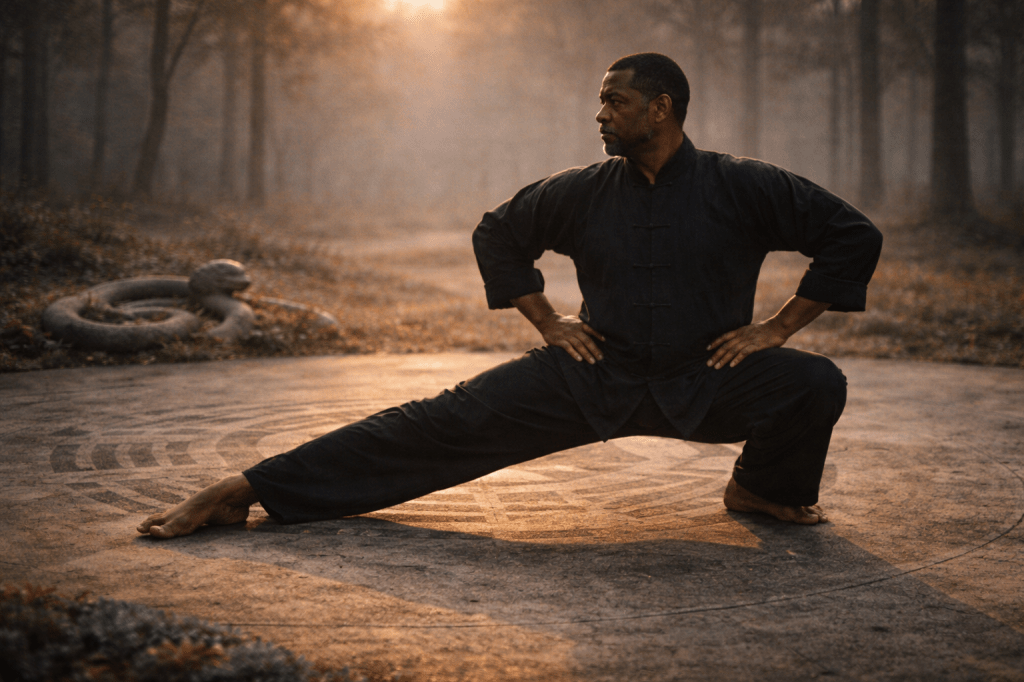
“Return is not retreat; return restores what was lost.”

I Ching

Stretching, then, stopped being something I did to my body. It became something I did with it. On rest days, stretching listens. After training, it soothes. During recovery weeks, it reminds the joints they still belong to me even when load recedes. It no longer pretends to build strength, erase DOMS, or override fatigue. It simply does what it does best: it quiets, it informs, it restores a sense of safety.

Where I stand now feels simpler and more honest. I stretch to calm the system, not to chase progress. I build range through strength, not persuasion. I read stiffness as information, not insult.

“Those who force do not endure; those who yield remain.”

Tao Te Ching

The body adapts faithfully, but it remembers how you approached it. Force teaches defense. Patience teaches cooperation. That lesson didn’t arrive through doctrine or debate. It arrived through years of showing up, listening late, and finally yielding at the right moment. Once I did, stretching stopped asking for belief—and started offering guidance instead.

Sifu Khonsura Wilson

Stay inspired & inspirational.

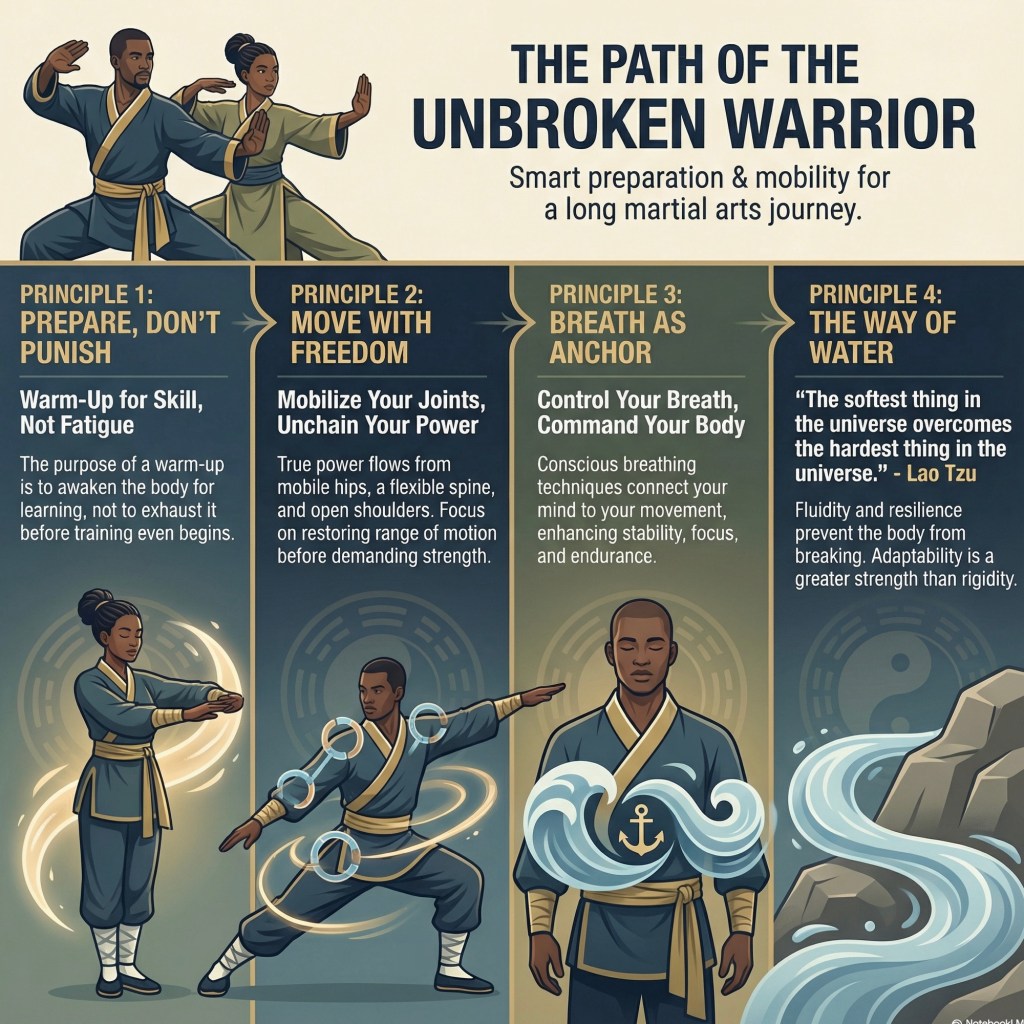
The Martial Arts Warm-Up: Preparing the Body for Skill, Not Fatigue

.A martial arts warm-up exists to prepare the body and the attention so training can happen safely, clearly, and with intention. It does not exist to exhaust students. Fatigue belongs elsewhere. Skill requires freshness. This distinction appears again and again in classical sources. The Tao Te Ching reminds us:

“Those who hurry do not arrive. Those who strain do not endure.”

A warm-up that rushes the body into exhaustion undermines the very training it claims to support. A warm-up done well clears the path so that learning can proceed without resistance.

This structure reflects traditional martial training logic—found across Shaolin, internal arts, and classical systems—while remaining practical for modern students who balance training with work, age, injury history, and recovery.

Phase 1 — IGNITE

(5–8 minutes)

The purpose of ignition is simple: raise body temperature, increase circulation, and gently elevate the heart rate.

Ignition movements wake the nervous system without draining the energy needed for learning. They replace stiffness with readiness and hesitation with rhythm.

This phase should feel light, repeatable, and steady. You should feel warm, not worked.

Examples include jumping jacks, light jogging, easy jump rope, or whole-body shaking. These movements reconnect the limbs to the center and remind the body how to move as a unit.

The I-Ching speaks to this moment through Hexagram 51, The Arousing (Thunder), which describes awakening without panic—

Movement that stirs life but does not scatter it.”

That is the spirit of ignition.

Phase 2 — MOBILIZE

(8–12 minutes)

Once the body is warm, the joints must be prepared.

Mobilization restores usable range of motion and prepares the body for rotation, bending, and load. Martial arts ask the body to turn, coil, sink, and extend under control. This phase oils the hinges before they are asked to bear responsibility.

Mobilization moves deliberately from the ground upward: ankles, knees, hips, spine, shoulders, elbows, wrists, and finally the neck. Breath remains steady and unforced. Movements stay circular and attentive.

Here, patience becomes part of training.

The Tao Te Ching teaches:

“The soft overcomes the hard. The yielding overcomes the rigid.”

Joint preparation embodies this principle directly. Rushed force stiffens. Gentle attention opens pathways.

Phase 3 — INTEGRATE

(8–10 minutes)

Mobility alone does not produce skill. It must be organized.

Integration teaches the body to use its newly restored range with control and structure. This phase bridges warm-up and training, turning looseness into alignment.

Stances, slow kicks, controlled transitions, and posture coordinated with breath belong here. Nothing rushes. Nothing collapses.

This phase quietly reveals balance issues, asymmetries, and tension habits—both to the instructor and the student. It is diagnostic without being punitive.

The I-Ching captures this moment in Hexagram 53, Gradual Development, reminding us that:

“Stability grows through ordered steps, not leaps.”

Phase 4 — TRAIN (Skill Work)

(45–60 minutes minimum)

This is the heart of class.

Training includes forms, drills, applications, partner work, correction, and repetition carried out with attention. It requires sensitivity, responsiveness, and enough freshness to perceive subtle errors and make real adjustments.

Anything less than forty-five minutes of focused skill work turns training into demonstration. Anything overloaded with fatigue turns learning into survival.

Class time prioritizes clarity.

As the Tao Te Ching states:

“To know how to stop is to be preserved from danger.”

Stopping short of exhaustion preserves both technique and spirit.

Conditioning (Homework)

Conditioning strengthens the body and builds endurance, but it does not belong inside the main teaching block of class. It does three important things at once. It keeps the class focused on learning rather than exhaustion. It signals that endurance matters without forcing it on everyone. And it respects different bodies, ages, and recovery capacities without apology or compromise.

Placing conditioning outside class allows technique to remain clean, instruction to stay focused, and students to scale intensity safely according to age, recovery, and personal goals.

Conditioning performed as homework may include jump rope rounds, high-rep calisthenics, roadwork, stance endurance, or extended form practice. These efforts matter—but they matter most when chosen deliberately rather than imposed universally.

Strength grows through restraint and proper containment.

I-ching

This approach honors both discipline and longevity.

Why This Structure Matters

  • This sequence protects joints.
  • It preserves attention.
  • It prevents burnout.
  • It respects beginners.
  • It supports long-term progress.

Most importantly, it teaches students how to train responsibly, not just how to move.

The I-Ching reminds us in Hexagram 26, The Taming Power of the Great, that strength grows through restraint and proper containment. Training that endures follows that wisdom.

If this structure affirms how you already train—or challenges habits you’ve taken for granted—that reflection itself counts as practice. You’re welcome to share your experience in the comments: how you warm up, what your body asks for before training, or what you’ve learned through time on the floor.

If this essay supported your understanding, feel free to like it or share it with someone you train with. And if you’d like to continue exploring martial arts through structure, tradition, and lived experience, you’re welcome to subscribe for future posts.

Begin well and train clearly, letting endurance come in its proper place.

Stay Inspired & Inspirational.

Sifu Khonsura R. Wilson

Martial Art Teaching Notes #001: Practical Principles from the Training Floor

“Those who rush ahead do not travel far.” — Tao Te Ching

Morning smog settled over the park like a silken veil, blurring the lines of the open field and turning it into an intimate classroom. The space let posture speak louder than intention, and mistakes surfaced without argument. I arrived early, not to mark territory but to read conditions: cool, damp air filled my lungs, stiffness lingered in my hips and shoulders, and echoes of yesterday’s work buzzed just beneath the skin. Training always begins before instruction, long before a student throws the first punch or asks the first question.

I opened the session the way I always do, with order rather than urgency: joints before jumps, alignment before aggression, breath before bravado. Wrists rolled under control, elbows circled without strain, shoulders loosened while staying connected, the neck unwound slowly so awareness stayed online instead of drifting upward into performance. Then hips opened, knees tracked, ankles woke, each rotation reporting what the body carried forward and what today would demand payment for. These early minutes rarely impress students, yet these minutes decide the tone of the entire session, because structure earned early saves energy later.

When things drift, escalation adds friction, while a return to root conditions restores control. I-Ching 24, Return 

From there, we moved into finger-up push-ups, not for toughness theater but for hand integrity, building pressure tolerance while keeping sensation intact. The drill teaches the wrist to withstand sudden impact, a key demand in martial training. I had him count rounds out loud so attention stayed present and effort stayed honest. We dropped next into low horse, thighs heating, breath tightening, posture negotiating with fatigue, and I ran him through a six-position drill, shifting angles without excess travel, learning the difference between movement and fidgeting, between changing position and changing power. Every training session eventually asks one question, whether the student hears it or not: Can structure hold while pressure negotiates for shortcuts? That question waited quietly until the punching began.

We moved into straight punches, then inner-gate and outer-gate lines, then chain punches, not as frantic volume but as cycling strikes fed by hip rotation, elbows heavy, wrists aligned, knuckles traveling along a clean line. The body organized well enough to matter. Contact arrived, and with it, the lesson surfaced immediately. He touched the line—range close, timing close, structure close—then habit intervened. Instead of adjusting from contact, he pulled back to reset, stepping out of range to restart the drill as if safety lived behind him and information lived ahead.

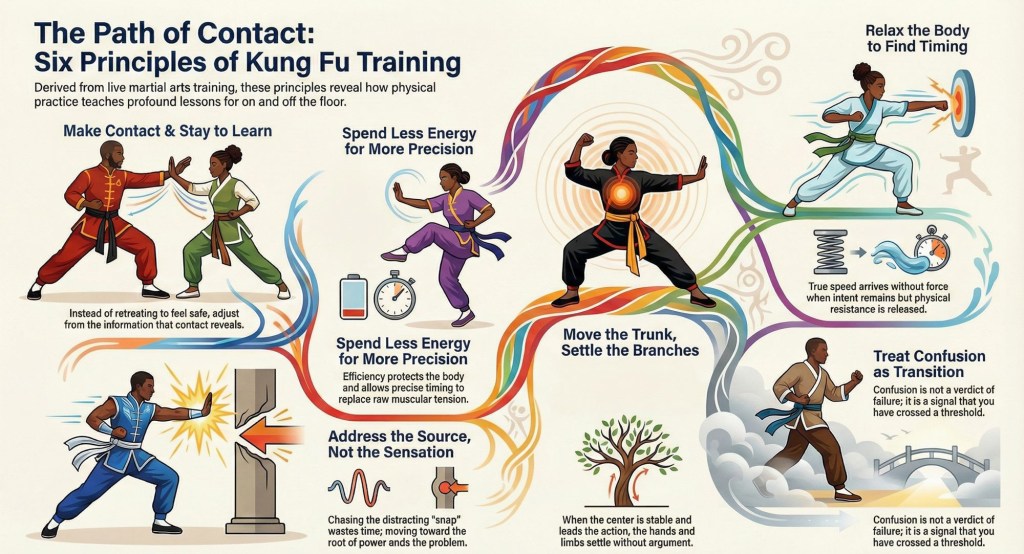
I stopped him on that exact beat, the moment where training either deepens or repeats itself, and gave the correction welded directly to the body in front of me: don’t pull back—finish from contact. A memory from my early training surfaced, a sparring exchange where I instinctively stepped back and left an opening my opponent exploited without hesitation. The lesson clarified itself: Abandoning contact meant abandoning the opportunity to learn and adapt. In Wing Chun terms, once the bridge forms, you don’t abandon it just to feel prepared. Contact delivers information—pressure, direction, imbalance—and pulling back discards that intelligence. The body then pays twice, first for the lost opening and again for the energy required to recreate timing. Students often call this reset “discipline,” yet discipline should look like adjusting from reality rather than restarting from fear. Laozi warns against unnecessary retreat and excessive striving, and that warning lands plainly here—stay with what happened long enough to let it teach you.

Abandoning contact meant abandoning the opportunity to learn and adapt.

Fatigue crept into the session, effort rose, and efficiency dropped. Shoulders climbed, breathing shortened, punches grew louder while accuracy thinned. I didn’t correct intensity; I corrected waste. I reminded him to use the least amount of energy required to get the result, not as a softening move but as a sustainability move. We dropped punch power to fifty percent and cleaned structure. The hip fed the hand, the elbow stayed heavy, and the strike landed cleaner because timing replaced tension. Efficiency protected wrists and shoulders, preserved the nervous system, and left enough capacity for the rest of the session and tomorrow’s work. Kung Fu never rewards exhaustion for its own sake; it rewards precision under conservation.

We shifted into elbow work—sink elbow, front elbow, recovery—and the snap triggered flinches. Shoulders rose, eyes blinked, and the body reacted to noise instead of mechanics. I introduced the next correction while the problem still lived in the body, reminding him to move toward the source, not the snap. The whip cracks loud at the tip, yet power lives near the hand. Like judging a storm by thunder instead of pressure change, chasing the crack wastes time, while closing toward the source ends the problem. In training, the snap shows up as flinch and tension, and the correction lives in breath dropping, ribs settling, hips turning. When the source aligns, the snap loses leverage. of I Ching Hexagram 24 ‘Returnnames the same motion: when things drift, escalation adds friction, while a return to root conditions restores control.

As rounds continued, the hands sped up without clarity, fluttering independently of the body, announcing effort while losing control. I didn’t argue with the hands. I moved the trunk. Stance widened slightly, shoulders softened, breath dropped, and hip rotation slowed and deepened. The hands settled without instruction because the center reclaimed leadership. Students often fight symptoms—slow reactions, frustration, uncoordination—while ignoring root conditions such as focus, posture, rhythm, and sensitivity. Training exposes this immediately. Move the trunk and the branches follow.

When things drift, escalation adds friction, while a return to root conditions restores control.

Mid-session, sweat rising and corrections stacking, he said the line every honest beginner says sooner or later: “I’m losing it.” I translated rather than reassured. Learning often feels like loss when old coordination dissolves and new timing hasn’t stabilized yet. The mind releases control before the body claims competence, and fog fills that gap. That fog signals entry into real training. The I Ching describes this phase repeatedly—return before advance, patience before clarity. This moment mirrors a familiar passage in training, where confusion marks transition rather than collapse. If confusion shows up here, the student didn’t fail; the student crossed the threshold.

Move the trunk and the branches follow.

We closed the session with the correction that protects joints and sharpens timing at the same time: relaxation generates speed. I coached mechanics rather than mood—jaw unclenching, shoulders dropping, elbows loosening, hips turning. As we ran chain punches again through a quieter body, knuckles hummed like tuned strings, resonating with a rhythm that spoke of both control and freedom. Speed arrived without force because rotation traveled cleanly. Intent stayed present while resistance left. Softness kept options open and allowed timing to arrive without strain.

I left Ken Malloy Park carrying the same corrections we worked through during the hour, not as slogans but as training notes written into the body. Teaching always works that way for me—my voice instructs the student while my ears instruct me, catching echoes of the same habits I correct in others when they surface in my own training and daily conduct. Every time I say finish from contact, I hear it aimed back at moments when retreat tempts me more than response.

Return before advance, patience before clarity.

So I keep the practice concrete and repeatable, the way martial knowledge prefers it. I make contact and stay in range long enough to learn, spend less energy so precision can show itself, address the source instead of chasing sensation, move the trunk so the branches settle without argument, treat confusion as a signal of transition rather than a verdict, and relax the body so timing can arrive without force—principles that don’t ask for belief but ask for repetition.

Run them on the mat, in forms, in sparring, and let experience confirm what instruction only points toward. Training does its job when repetition teaches what words only gesture toward. Which drill will you test these principles in today?

Stay inspired… and stay inspirational.

— Sifu Khonsura Wilson