Yesterday’s sparring session stayed with me long after the rounds ended…
At first, I thought mostly about what did not come out the way I wanted. My timing did not always land. My guard did not always protect the line. My pacing faded in the later rounds. My opponent’s head movement, fading, angling, and baiting pulled my attention in several directions at once. The first few rounds gave me enough space to breathe, observe, and adjust. By the last round, fatigue had started talking with a little too much confidence.
Still, beneath all of that, the session gave me something valuable.
It reminded me that traditional Kungfu forms contain more than choreography. They preserve patterns of movement, strategy, structure, and timing that may not reveal themselves fully until pressure enters the room.
Many practitioners dismiss forms too quickly. They look at a sequence and see performance, ritual, repetition, or cultural preservation without practical use. Others travel in the opposite direction. They practice forms faithfully, sometimes beautifully, but never pressure-test the movements enough to understand how the form behaves when another person refuses to cooperate. Both errors miss the bridge.
The form preserves the pattern.
Pressure reveals the function.
During the session, I asked Sifu for pointers. He showed me how to offset kicks, how to avoid standing directly in the path of incoming force, how to use angle, body position, and timing rather than panic. As I watched him move, I started noticing things I had trained for years without fully recognizing their practical shape. The ducking. The leaning. The head movement. The fading. The subtle repositioning that keeps the body from becoming an easy target. These were not foreign movements. They were not outside the art. They had been living inside my own training, waiting for the right pressure to explain them.
That realization hit me with quiet force.
Sometimes the art has already given us the answer, but we have not yet met the problem clearly enough to recognize it.
One movement stood out especially. I noticed how he could neutralize my guard while striking at the same time. He would catch, redirect, or control the bridge, then enter before I had time to reset. It reminded me of what we sometimes call a seven-wrist type of attack, where the hand circles around the incoming punch, hooks or controls the wrist from the inside, pulls the line inward, and strikes simultaneously. In form practice, that kind of motion can look formal, even decorative, especially when no one explains its fighting logic. Under pressure, however, it becomes direct. It says: control the bridge, occupy the center, strike while entering.
That lesson clarified something I have worked on for years: the ability to strike and defend simultaneously. Not block, pause, then strike. Not receive force as one event and answer later as another event. Rather, train the body to manage both ideas in one action: cover and enter, deflect and strike, avoid and return, protect and advance.
Of course, knowing this concept and applying it under pressure do not mean the same thing. Sparring exposes that difference quickly. The mind understands one thing while the nervous system negotiates speed, uncertainty, fatigue, impact, pride, and surprise. That gap can humble any sincere practitioner. A movement that feels clear in solo practice can feel slippery when the other person changes rhythm, hides intent, shifts angle, or sets bait.
I found myself making the same mistake more than once. Part of me knew I kept moving in the same direction. Another part of me wanted to understand exactly what he was doing. So I kept testing the line, not because it worked, but because my brain wanted to study the trap from inside the trap. That may not win a round, but it can teach a lesson. Sometimes you have to feel the same door close several times before you understand the hinge.
The deeper lesson came through my breathing. Even when I tired, I noticed that I could regulate my breath better than I expected. I did not completely lose myself. I did not fall for every piece of bait. I could observe more than I could execute. That matters. Before the body can respond correctly, the mind has to remain present enough to notice what happens. Breath gives attention somewhere to stand.
Now I see the next stage more clearly. I need countermeasures. I need to study how he neutralizes my guard. I need to train responses to fading, head movement, and angle changes. I need to build patterns that let me recover position after missing or getting drawn out of structure. I need to add certain defensive and offensive motions from the forms into my foundational warm-up—not as random techniques, but as living bridges between solo training and pressure.
That point matters.
Traditional forms do not automatically make a person effective. Repetition alone does not guarantee application. However, form practice gives the body a library of shapes. Sparring teaches the body when those shapes matter. Over time, the gap between form and event begins to shorten. The brain stops treating application like a theory and starts recognizing it as a familiar shape arriving at speed.
This may explain why experienced practitioners often find new meaning in old movements. A beginner may need form to build coordination, posture, rhythm, discipline, and memory. An intermediate student may need drills to connect isolated movements to practical ideas. A mature practitioner may return to the same form after years of training and suddenly see a bridge hand, a kick defense, a trap, a throw, an angle, a recovery step, or a way to hide the body from attack.
The form did not change.
The practitioner changed.
Pressure changed the question.
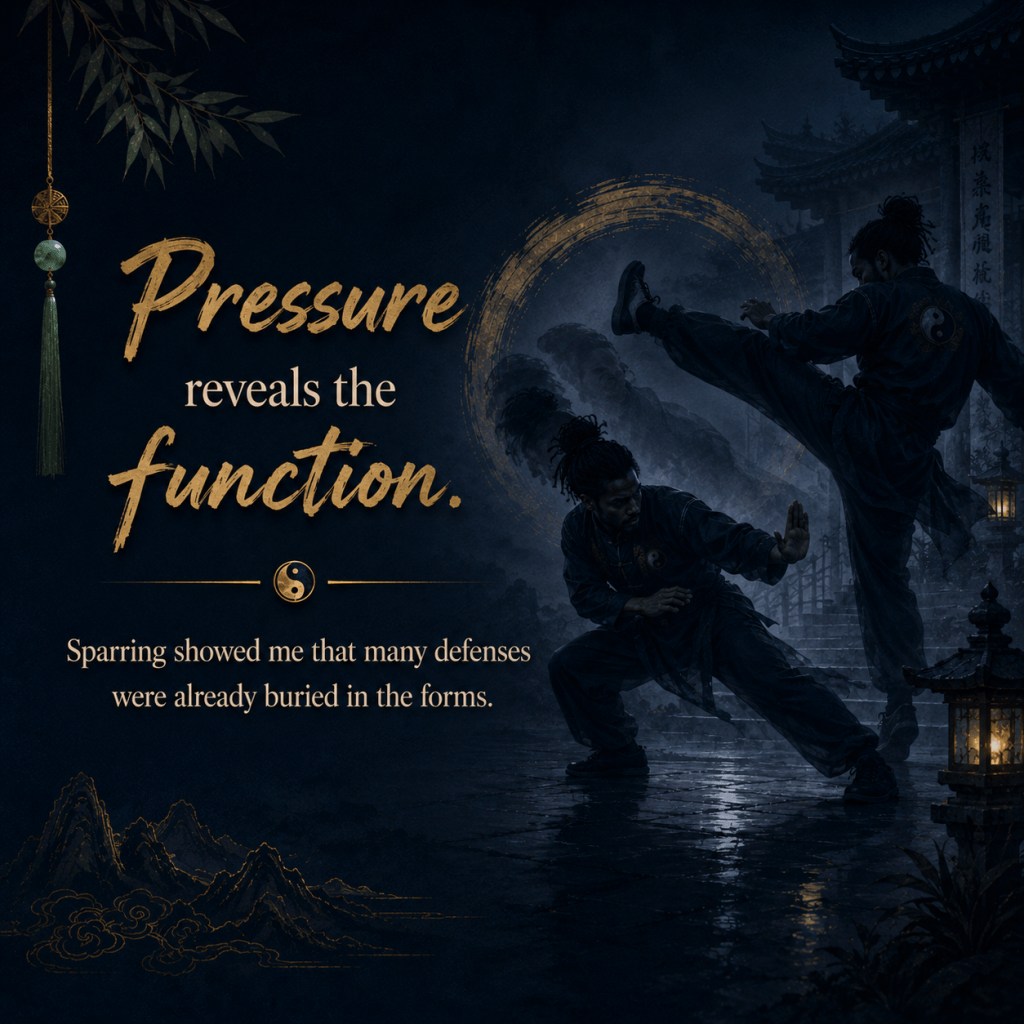
After more than two decades of study, I still feel like I am trying to figure this Kungfu thing out. That does not discourage me. In fact, it gives the practice depth. If everything revealed itself quickly, the art would feel shallow. Instead, the training keeps unfolding. A movement I once treated as simple choreography can later return as strategy. A correction I once missed can later become a key. A sparring round that bruises the ego can open a door that comfort never touches.
That may be one of the great gifts of Kungfu. It rewards patience. It punishes fantasy. It preserves tradition, but it demands honest testing. It gives us forms, but it does not let us hide inside them. It gives us techniques, but it requires timing, courage, breath, and humility before those techniques become useful.
So I will keep training the forms.
I will keep pressure-testing the bridge.
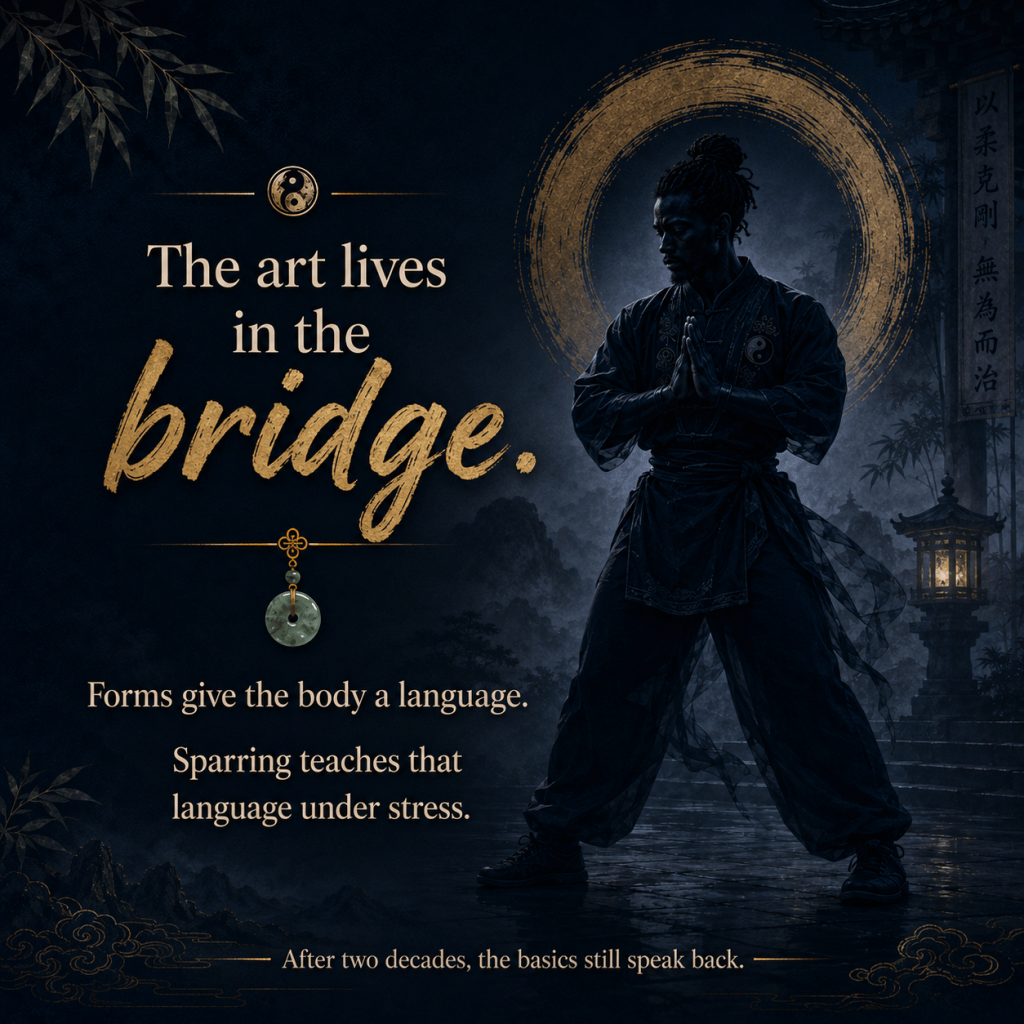
I will keep studying where my structure collapses, where my breath holds, where my guard opens, where my timing fades, and where an old movement suddenly begins speaking in a new voice.
Traditional Kungfu forms contain the technique, but pressure reveals the function. The form preserves the pattern. Repetition wires the pattern. Sparring shortens the gap between pattern and event. Over time, the brain stops treating application like a theory and starts recognizing it as a familiar shape arriving at speed.
That sentence now feels less like a slogan and more like a fieldnote from the floor.
The art keeps teaching.
The question is whether we keep listening.
Sifu Khonsura A. Wilson


