Why Smallness Wins: Tao 42 on Power Without Posture

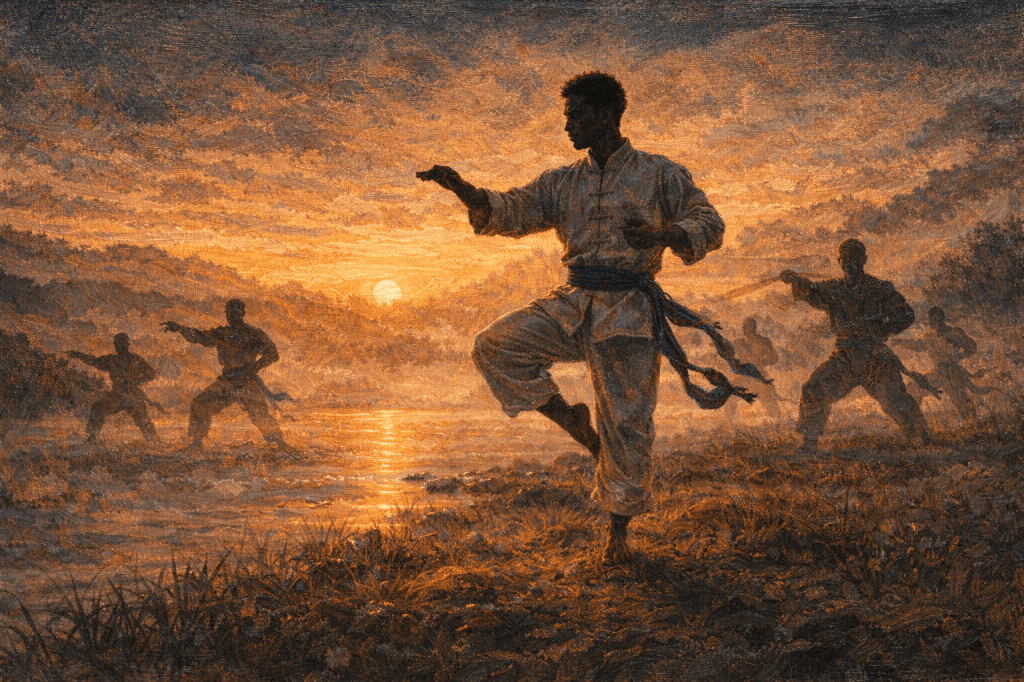
I stepped outside before the sun finished deciding on its color, carrying tea heat in one hand and quiet in the other, letting the morning air cool my face while my body negotiated stiffness through small adjustments, humble and precise, more honest than heroic. I didn’t chase revelation, because I wanted rhythm, and Tao Te Ching 42 offered rhythm without theatrics, steady as an elder’s hand on the shoulder: Tao gave birth to one; one gave birth to two; two gave birth to three; three gave birth to the ten thousand things.

We can read that as cosmology and still miss the instruction, because Laozi sketches a pattern that repeats through our training, our teaching, our talking, our living: coherence, polarity, relationship, then consequence. We start with one impulse, one intention, one decision, and then a counterforce arrives—another person’s mood, a deadline, a stubborn knee, a student’s confusion, a spouse’s fatigue—and as soon as that counterforce touches us, exchange begins, and exchange multiplies into outcomes that later feel inevitable only because we missed the pattern early enough to steer it.

I hear “one” as coherence, as a single pulse that doesn’t need performance, as a root that holds without gripping, and I hear “two” as polarity, as the tension between press and yield, firmness and softness, silence and speech. I hear “three” as relationship, as the living field that rises when opposites stop posturing and start conversing, because yin and yang, once they touch with skill, produce something new, not a compromise and not a blur, but a workable rhythm that keeps moving while it stays stable.

We recognize that rhythm quickly in martial training, because the body refuses to lie about balance. Structure without flow turns rigid; flow without structure turns sloppy; but structure meeting flow produces power that travels through alignment instead of ego. We practice that every time we root the feet and release the shoulders, every time we hold guard without clenching, every time we enter and exit with timing instead of temper, and we learn, sometimes the hard way, that timing doesn’t arrive through force; timing arrives through blending.
I keep returning to the chapter’s image of posture and breath: the ten thousand things carry yin on the back and hold yang in the embrace, and harmony arrives through the blending of vital breaths. Yin asks for receptivity, listening, quiet strength, patience under pressure; yang asks for decisiveness, expression, boundary, forward motion when alignment supports action. When I carry yin, I reduce overreaction; when I hold yang, I reduce under-response; when I blend breath with breath, I stop swinging between extremes like a door with loose hinges, and I start moving like a hinge that knows its purpose.

We all know those extremes, and we all pay their price in the same places: jaw, shoulders, stomach, sleep, tone, timing. Too much yang sends us into hurry and heat, then into sharp speech that lands like elbows in a crowded room; too much yin sends us into avoidance and vagueness, then into shrinking that later ferments into resentment. Balance doesn’t fall from the sky. Balance grows from practice, and practice begins in breath and posture, then extends into speech and choice, because the way we breathe shapes the way we respond.

I love how Laozi pivots from metaphysics into status with a grin hidden behind the robe: people despise helpless, little, worthless, and yet princes and barons choose those names for themselves. That reversal grabs me because it exposes a strategy modern life forgets. When I cling to a title, I start defending image instead of refining skill, and defense drains energy that practice could use, like shadowboxing in a mirror and calling it progress.
We can call that strategic humility, and we can treat it as advanced training rather than timid personality. Smallness keeps us adjustable. Smallness keeps us teachable. Smallness lowers the temperature in the room so clarity can enter. In sparring, the stiff striker breaks first; in conversation, the stiff mind fractures first; in teaching, the instructor who must look brilliant stops listening, and the moment listening stops, learning stops. Smallness practiced with dignity keeps the hinge oiled, and an oiled hinge outlasts a slammed door.

I sit with the paradox next, because it refuses simple accounting: one may gain by losing, and one may lose by gaining. I treat that line as ledger-work. When I lose pride, I often gain peace. When I lose the need to win, I often gain relationship. When I lose speed in training, I often gain alignment that protects knees, hips, spine, the whole future. Yet when I gain applause, I might lose silence. When I gain status, I might lose sleep. When I gain efficiency, I might lose depth. Every gain drags a shadow behind it, and every loss opens a doorway somewhere, and the only question that matters concerns attention: will I count honestly, or will I count only what flatters me?

We see this clearly in practice, because the body invoices every shortcut. Power without structure can injure joints. Speed without root can wreck balance. Victory without control can poison character. We can “win” a moment through ego and still lose the relationship that would have supported us for years, and we can chase flash in technique and still pay for it later in cartilage, tendons, and regret. Laozi doesn’t condemn ambition; Laozi refines ambition, asking us to measure success by harmony rather than spectacle, because harmony supports everything else like a good stance supports every strike.

I hear the chapter’s closing as pattern recognition, not threat: a person who cultivates violent posture often meets violent endings. Violence multiplies. Violence echoes. Violence trains the nervous system toward constant readiness, and constant readiness shortens breath, and short breath shortens patience, and short patience shortens relationships. A violent posture, once practiced, starts practicing the practitioner, and that practice spreads outward, touching family, classroom, street, and self.
We can extend the logic without pretending life promises fairness: a person who cultivates peace can cultivate a peaceful end. Peace doesn’t guarantee safety, and peace doesn’t cancel tragedy, yet peace shapes character, and character shapes choices, and choices shape the texture of our days. Peace steadies breath. Steady breath supports clear perception. Clear perception supports cleaner decisions. Cleaner decisions reduce unnecessary harm. That chain doesn’t sparkle, yet that chain holds, and I trust what holds more than what shines.

I returned from the walk with no fireworks, no cosmic announcement, only a quieter spine and a calmer mind, and that felt like the real gift. Tao 42 didn’t hand me a slogan; Tao 42 handed me a practice: carry yin without collapse, hold yang without aggression, blend breath with breath, practice smallness without shame, examine gains for hidden costs, and choose peace as discipline rather than decoration.

We can carry that practice into the next hour without building a ceremony around it. We can listen one beat longer before we answer. We can soften shoulders before we speak. We can slow one movement in training to protect alignment. We can step forward once with clean intention instead of ten times with anxious force. We can treat harmony as a kind of strength that never needs applause, because harmony doesn’t beg for attention; harmony keeps working.

I’ll leave you with this, friend to friend, teacher to training partner: brilliance without blending burns people out; smallness practiced with dignity keeps us adaptable; peace practiced daily shapes the texture of an ending. I’ll keep that line in my pocket as I move through the day, and I hope you carry it too, not as doctrine, but as direction.

Stay inspired… andinspirational.

— Sifu Khonsura Wilson
AUDITIONING FOR MY OWN LIFE : What Happened When I Stopped Trying to Impress the Day?

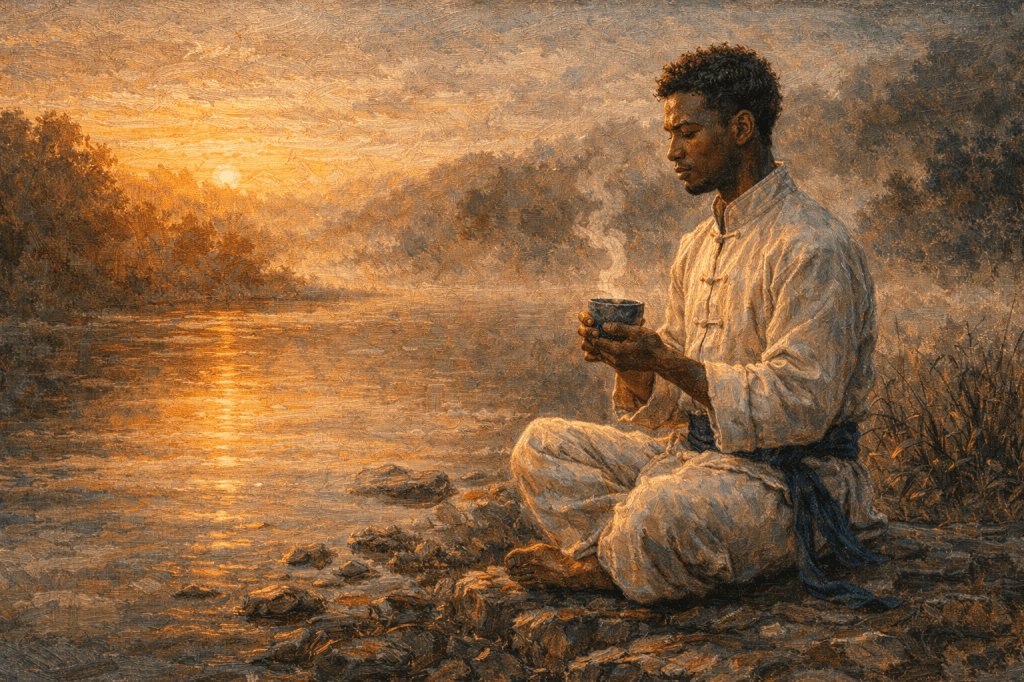
I didn’t set out to learn anything profound today; I set out to unstiffen—to walk the dogs, sip sunlight, shake travel out of my calves, and let the ordinary reassemble itself, one footfall at a time, while my mind wandered the way a tired hound wanders, sniffing at every thought like it might carry a scrap of meaning. Somewhere between movement and stillness—between training and refusing to bully my own body into obedience—I caught an extra effort riding on my shoulders like a backpack I never consciously strapped on, effort not only in muscle and tendon but in attention itself, in the forward-lean of my thinking, in that reflex to hunt a takeaway and turn quiet into product.

“Do the work; then step back.”

That pressure had grown familiar lately, so familiar I almost renamed it discipline, because reflection began demanding performance, insight began demanding outcomes, reading began demanding application, and the inner voice kept whispering, So what will you do with this?—a little hustler-question in a silk robe, pretending it carried wisdom. I kept walking anyway, letting the question trail behind me like a kid tugging my sleeve, and the longer I walked the more its grip slackened, because some things resist extraction, refuse leverage, dodge proof, and ask instead for breath, body, lived time; once I stopped squeezing every moment for juice, the day widened, quietly, like a tight belt unfastened after a long drive.

“Nature does not hurry, yet everything gets accomplished.”

Tai Te Ching

Earlier, I opened 365 Tao: Daily Meditations by Deng Ming-Dao, then turned to the Tao Te Ching—Chapter 34 in one translation, and later a passage from William Martin’s The Sage’s Tao Te Ching and that old description of the Tao met me again—vast and universal like a flood—nourishing without bragging, carrying without claiming, doing the work without demanding applause, feeding and clothing the ten thousand things without lording over any of them. The passage kept pointing toward a paradox that tamps down my ego in the gentlest way: greatness completes itself through refusal of grandstanding, and power ripens through quiet anonymity, roots holding the whole tree upright while no one claps for roots.

“The highest good resembles water.”

Tai Te Ching

That thought followed me through the afternoon—not as a lecture, not as a moral poster on a wall, but as a living question walking beside me: what might my day feel like if I moved through it without insisting on greatness, pushing for proof, or trying to win at existence? I don’t mean shrinking, and I don’t mean performing humility with a hidden hunger for compliments; I mean stepping forward with a relaxed jaw, working with clean effort, showing up to live the day instead of conquering it. Modern life trains us to confuse force with effectiveness—push harder, post more, sharpen the opinion, optimize the routine, tighten the timeline—until creativity wears a necktie and carries a clipboard, checking its own pulse, asking the algorithm for permission to breathe; I’ve watched that training take hold in me, especially around output, where “great” can sound like a spiritual goal while behaving like a small addiction.

Later, I opened William Martin’s The Sage’s Tao Te Ching, and his phrase—“agent of grace”—struck the same chord from a different angle: welcome in inhospitable places, no threat in the posture, no harm in the hands, people softening without coercion, minds opening without argument, kindly words moving where crowbars fail, families shifting through warmth instead of warfare. I didn’t take that as moral instruction; I took it as a reading on temperature. Some people step into a room and the air tightens—shoulders rise, jokes thin out, everybody braces. Others arrive and the room relaxes—faces open, voices soften, time slows enough for truth to slip through. Nothing mystical required, only presence, posture, tone, and a subtle decision to enter with no spear hidden behind the smile.

“A soft tongue can break a bone.”

Tai Te Ching

Then the day put its own evidence on the table, plain and practical. Training improved the moment I softened my shoulders and let my stance widen a half-inch, the sequence switching from resistance to rhythm; planning cleared when I stopped stacking demands like dishes in a sink already full; reading deepened when I stopped interrogating every page for productivity. The yard asked for water, not renovation. The body asked for movement, not conquest. The mind asked for space, not answers. Even the dogs—honest snouts, unbothered priorities—kept reminding me that life never needs a résumé to count as real.

Grace, as the afternoon kept teaching it, doesn’t cancel effort; grace refines effort, turning action away from threat. Grace looks like influence without insistence, strength without swagger, the kind of strength that doesn’t photograph well because it doesn’t beg for witnesses. Force can win compliance, sure, but force rarely wins openness; force moves bodies, grace moves hearts, hearts move habits, habits move futures, and that chain matters more than the short-term satisfaction of “winning” a moment.

“The soft overcomes the hard.”

Tai Te Ching

That recognition swung my attention outward, toward family gatherings, workrooms, classrooms, online spaces—places that harden fast when someone enters trying to win, correct, dominate, or impress, then soften when someone enters trying to understand, to listen, to contribute without tightening the air. Acting without lording over things doesn’t require disappearance; it requires refusal of domination’s posture, refusal of the contest-mind, refusal of greatness as the goal, because greatness—chased directly—shrinks into performance, while greatness—approached sideways—widens into service. Something quietly radical lives there, a stance that refuses trend-chase and trophy-hunt, choosing steadiness over spectacle—no viral victory, no dramatic reveal, just disciplined softness that changes a room by refusing to threaten it.

By the time I turned back toward home, nothing resolved itself, and that felt right; the dogs slowed, the light slanted, my legs loosened, and the day kept walking beside me without demanding a conclusion. I didn’t gain a shiny new identity called wiser, and I didn’t earn anything notable enough for a highlight reel. I simply eased off the push for a while, and in that easing something essential returned—steadier stride, quieter mind, cleaner attention—and I remembered a truth modern life keeps trying to edit out: usefulness doesn’t always announce itself as success.

Sometimes usefulness arrives as grace—quiet, capable, unthreatening—doing the work, leaving the air softer than it found it.

Stay Inspired and Inspirational

Sifu Khonsura Wilson

Recommended Reading

Deng Ming-Dao, 365 Tao: Daily Meditations

Lao Tzu, Tao Te Ching (try multiple translations; each one turns the gem a little differently)

William Martin, The Sage’s Tao Te Ching: Ancient Advice for the Second Half of Life

The Middle Space

There’s a moment when life keeps working, yet meaning stops announcing itself.

Many of us enter a middle space without announcement, a quiet interval where life keeps moving and responsibilities keep landing and practice keeps continuing, yet inspiration stops arriving on demand and meaning begins thinning the way warmth thins when a season turns. Nothing collapses, nothing calls for rescue, and that lack of drama makes the moment difficult to name, because we don’t burn out and we don’t disappear, we continue showing up—training, working, caring—while something essential drifts just out of reach, not gone, not lost, simply waiting, as if depth itself has stepped slightly to the side to see whether we will slow enough to notice.

This middle space doesn’t belong to the frantic or the disengaged; it belongs to the capable, the conscientious, the disciplined, the ones whose lives function well enough that dissatisfaction feels almost illegitimate. We learned to expect breakdowns or breakthroughs, yet this place offers neither, offering instead steadiness without fulfillment, competence without resonance, motion without direction. It often appears after years of doing the right things reasonably well, which creates a quiet tension, because gratitude and restlessness travel together, and we can’t tell whether the discomfort signals failure, fatigue, or something more subtle trying to reorganize from the inside.

“The sage does not hurry, yet nothing remains undone.”

Tao Te Ching

What often goes unnamed, though, carries the most consequence: this middle space doesn’t signal stagnation, it signals preparation. Taoist wisdom points toward transformation that arrives not through force or acceleration, but through inhabitation, through integration, through allowing insight, practice, and lived experience to settle into deeper alignment. In this space, life doesn’t ask for reinvention; it asks for rooting, for letting what we already know sink more fully into how we move, how we relate, how we practice, how we contribute without draining ourselves thin. And perhaps the real question doesn’t ask how we escape this space at all, but whether we recognize it as the very ground where quiet transformation begins—So how about you?

Do you live inside the Middle Way long enough for it to change you, or do you pass through it without noticing what it offers?

Stay Inspired and Inspirational

Sifu Khonsura Wilson