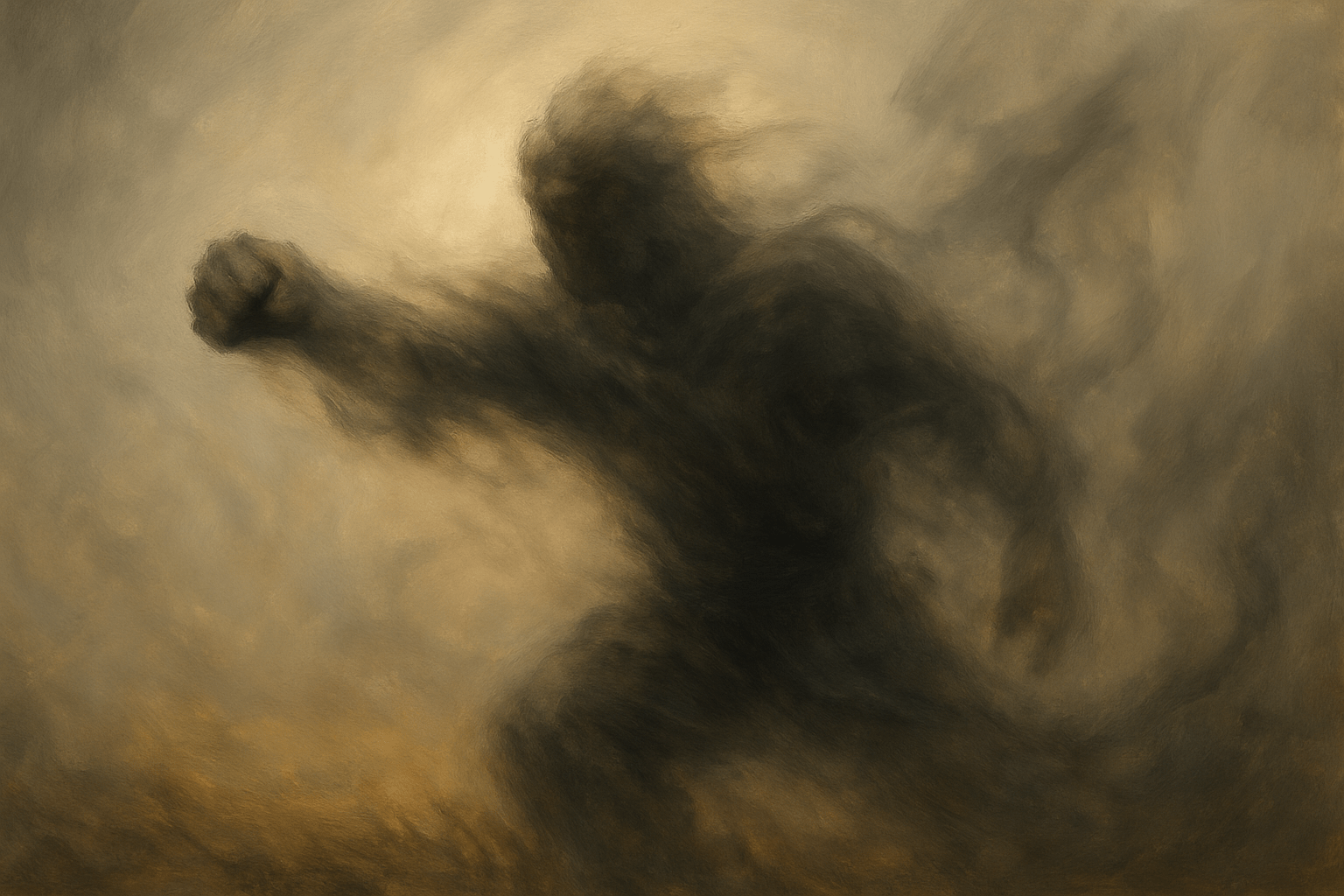
THE LIE FEAR TELLS

Fear arrives in disguise long before we recognize its footsteps. It slips in through old memories, stray thoughts, and sudden shadows, wearing the face of a future that has not happened and speaking with the authority of a truth it never earned. When fear catches us off guard, we treat it as prophecy. When we slow down long enough to listen, we realize fear often tells us more about our breathing than our destiny.

Most of what we call fear begins as a sensation, a tightening in the chest or a shift in the breath that the mind rushes to interpret. A noise in the bushes becomes danger, a delayed reply becomes rejection, an unfamiliar challenge becomes a script of inevitable failure. The body sends a whisper; the mind writes a novel. And in that gap—between sensation and story—fear finds its power.
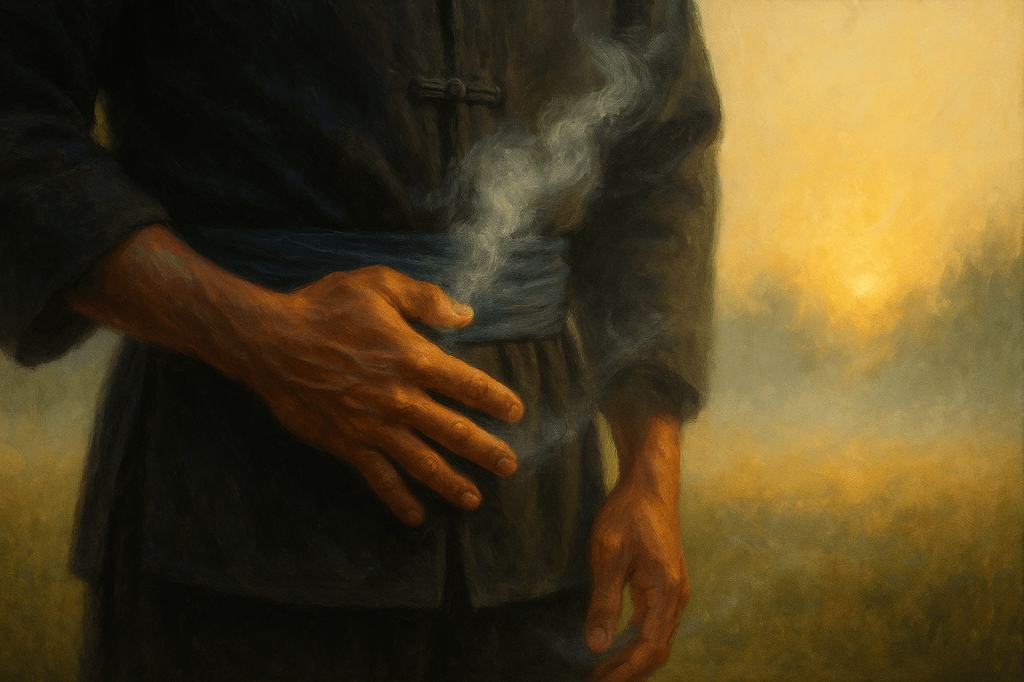
I have learned, slowly and sometimes stubbornly, that fear grows wildest in the absence of attention. When I react too quickly, fear plays puppeteer. When I pause, even for a single breath, fear loses the illusion of control. The breath steadies, the ground returns, the moment expands. Much like a novice attacker in sparring who swings too hard and too fast, fear telegraphs everything when you stop flinching at its first move. It lunges wide, hoping the surprise will overwhelm you. But if you root your stance, if you let your breath settle into your belly, the punch reveals its beginner quality. You see openings you could not see before. You see the difference between danger and anticipation.

Humor helps too—not the forced laughter we use to avoid discomfort, but the low, honest laugh that rises from recognizing how dramatic our minds can be. A laugh loosens the shoulders. A laugh signals safety. A laugh reminds you that fear does not hold the final word unless you surrender the sentence to it. Humor works as a soft blade, not to cut fear down, but to cut through the theatrical costume fear wears when it wants to look larger than life.
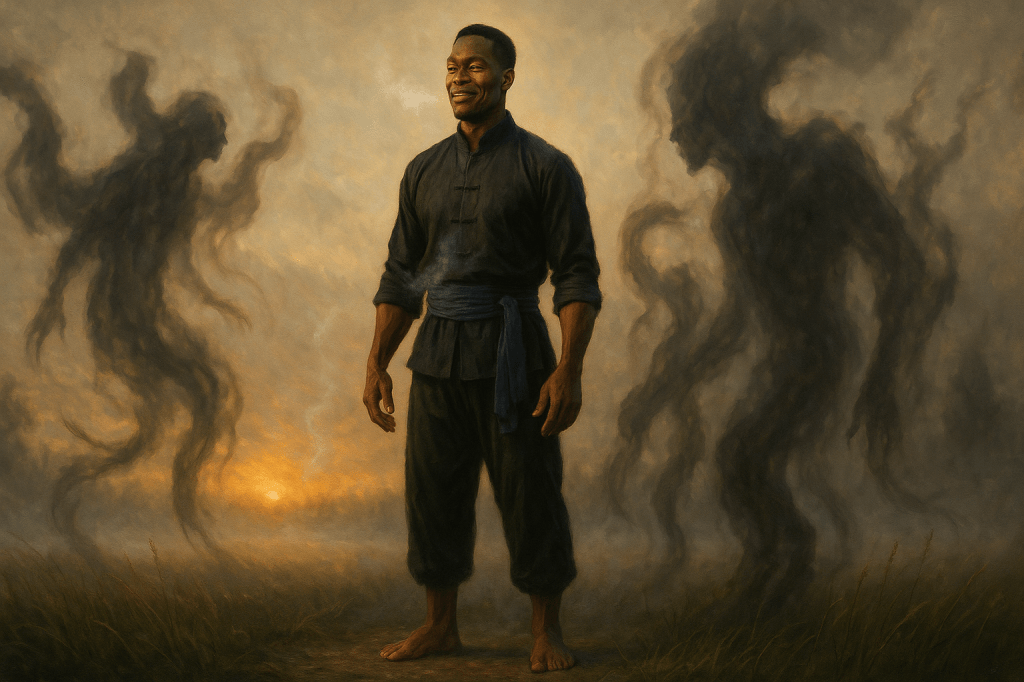
With time, fear stops appearing as an enemy and starts revealing itself as a form of weather—real enough to register, fleeting enough to pass. Some days feel overcast, heavy with low pressure inside the chest. Other days feel clear, the horizon open and wide. But no matter what fear predicts, it behaves like weather: it moves, it changes, and it rarely speaks for the entire sky.

The shift came for me when I stopped asking, “Why do I feel this way?” and started asking, “What exactly did I feel first?” The moment I name the physical sensation—the warmth rising in the sternum, the quickening of breath, the narrowing of attention—the story begins to lose its grip. Sensations belong to the body. The story belongs to the imagination. And the imagination loves exaggeration the way fire loves dry leaves.

Fear dissolves the moment our awareness grows brighter than the story fear tells.

Fear expands most aggressively in the absence of evidence. Once I ask fear to “show the receipts,” most of its arguments crumble. Prediction dissolves into possibility; possibility dissolves into choice. That small moment of clarity—of separating what happened from what might happen—turns fear from a ruler into a messenger. And messages, once heard, rarely need to shout.

What helps me now is simple: I acknowledge the sensation, breathe into the space it tries to occupy, shift my stance—even a literal shift helps—and choose one grounding act. Sometimes I laugh. Sometimes I move. Sometimes I create. Sometimes I call someone who reminds me of the larger world beyond the narrow tunnel fear wants me to crawl through. Each choice redirects the energy fear tries to monopolize. Each choice reminds me that presence remains more powerful than prediction.

Fear dissolves the moment our awareness grows brighter than the story fear tells. Fog does not leave the field because the fog decides to retreat; it leaves because light rises.

And every one of us carries light, even when we forget the switch exists.

Stay inspired & inspirational.

— Sifu Khonsura A. Wilson

Where Joy Goes When We Share It

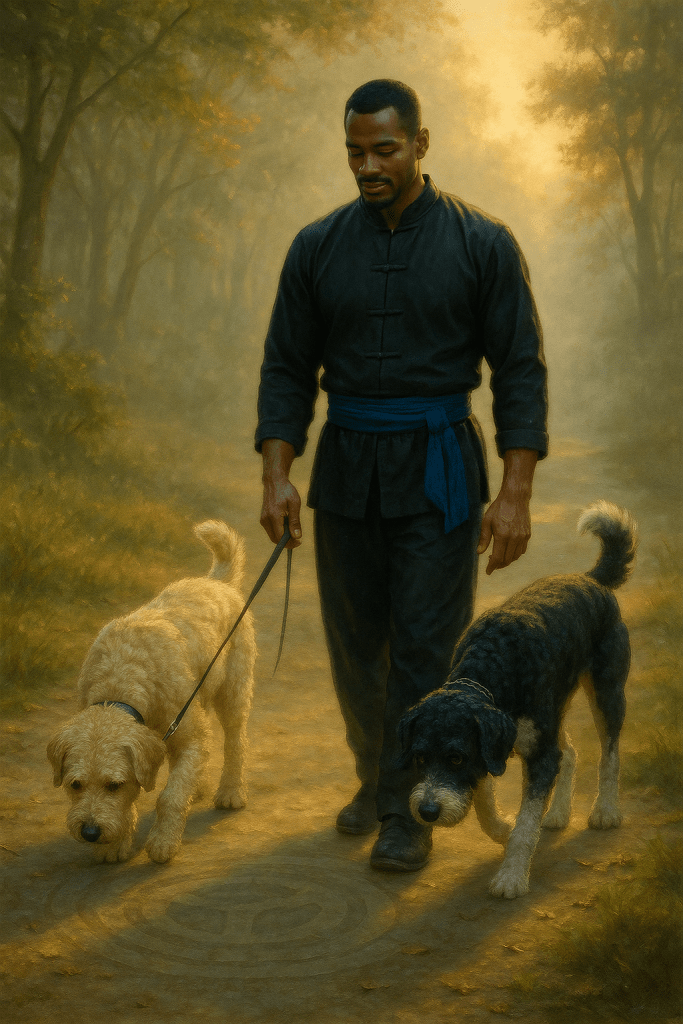
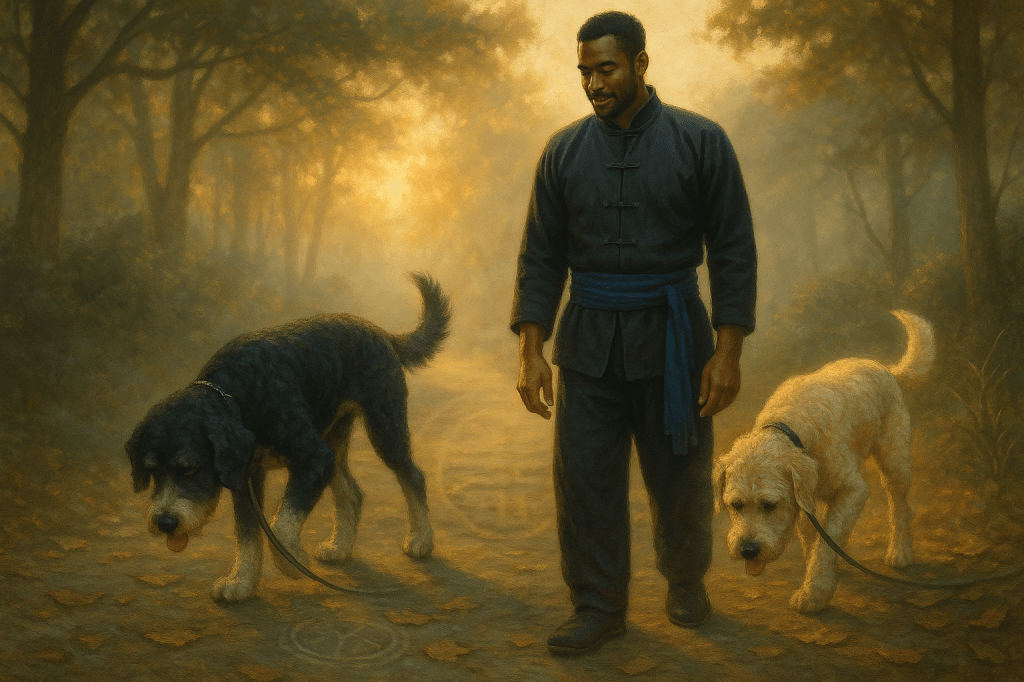
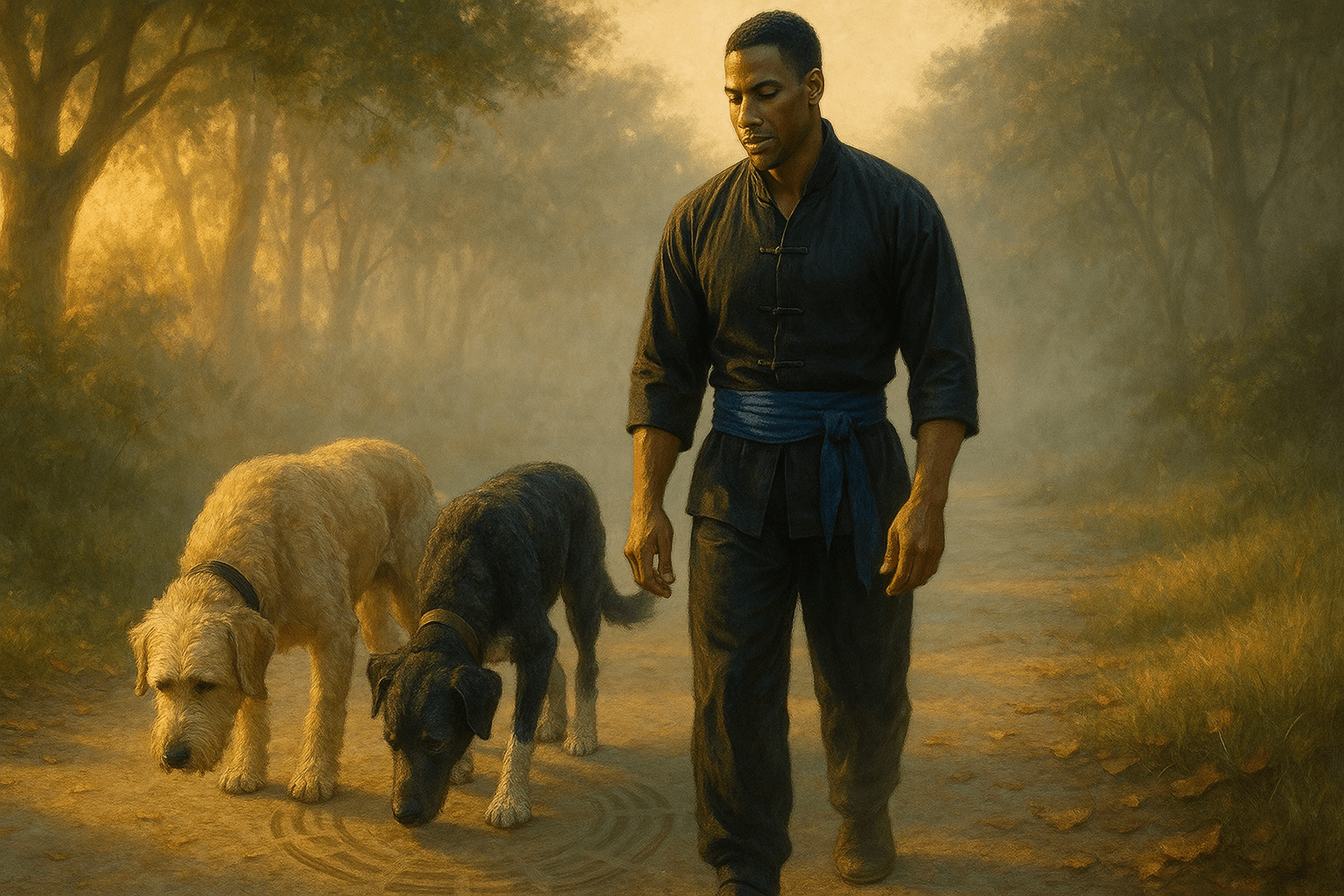
I stepped into the morning expecting little more than a quiet walk, yet the moment Caesar drifted toward the first patch of grass and Anubis followed with that steady, curious gait he adopts at dawn, something in the air widened. Their noses dipped toward the earth with a kind of reverence, as though each scent offered a subtle invitation, and I felt myself soften into the rhythm they already understood. Joy entered quietly, the way morning light gathers on the edges of things before anyone notices.

Their attention flowed naturally—not from leaf to soil to wind-shaped traces in a tidy sequence, but from whatever pulled their senses gently forward, the earth itself determining their curiosity. Watching them stirred a recognition I had nearly misplaced: joy often begins in the body before the mind gives it permission.

With the patient curiosity of a novice monk, Caesar lingered over a cool scatter of leaves while Anubis circled a single stalk of grass. Their devotion to noticing reshaped the moment, turning an ordinary walk into something contemplative.

Joy often begins in the body before the mind gives it permission.

Yet as the walk settled into this gentle ease, another truth pressed against it—one I resisted at first. Joy rises easily when the world cooperates, but what of the mornings when nothing offers itself freely? What of the days when attention feels heavy, when gratitude hides behind fatigue, when wonder refuses to appear on schedule?

That contradiction unsettled the simplicity of the moment. It reminded me that joy does not always arrive as a gift. Sometimes it demands a willingness to open anyway, to soften even when the world feels unyielding. That tension created a hinge.

I realized joy deepens not because conditions align, but because we choose to let small things matter even when we are tempted to overlook them. Caesar, still absorbed in his quiet investigation, had no concern for the state of the morning; Anubis, tracing a scent only he could decipher, had no interest in whether joy felt philosophically coherent. They didn’t negotiate with the day. They participated in it.

Joy’s strength lives not in circumstance but in connection.

This recognition shifted my thinking more than I expected. Perhaps joy is not fragile at all—perhaps it grows strongest when our mood gives it no help. And if that’s true, then the ease I felt this morning was not the source of joy but one expression of it, a reminder rather than a requirement.

What surprised me most was how naturally their wonder extended mine, how their undivided curiosity almost insisted I match it. Joy traveled between us—not as effort or performance but as a quiet invitation. It felt less like something I discovered and more like something I stepped into, already waiting in the shared space between our lives.

The thought settled then, without ceremony: joy goes where we share it, and returns fuller when we let it pass through us rather than hold it in reserve. It becomes steadier when offered, warmer when received, and more honest when unforced.

By the time we turned toward home, nothing dramatic had changed in the world, yet something spacious had opened in me. The dogs padded beside me—content, unhurried—and their simple companionship revealed again what I often struggle to remember: that joy’s strength lives not in circumstance but in connection, in moments where beings breathe the same air and find wonder in each other’s presence.

Joy goes where we share it, and returns fuller when we let it pass through us rather than hold it in reserve.

While we crossed the threshold back into the house, I carried the truth with an ease that felt earned: joy widens where we share it, deepens when we release it, and lives longest when we let it move beyond us.

Stay inspired and inspirational.

— Sifu Khonsura A. Wilson
On Outgrowing Without Losing the Love

When love changes shape, the heart learns new ways to walk forward.

This morning, I came across a reflection that stirred an old memory of a passage from 365 Dao by Deng Ming-Dao. The passage offers a quiet wisdom about companionship, gratitude, and the natural rhythm of parting:

“We meet others at the crossroads, walk together for a while, and eventually part because no one can carry another for long. Friendship carries no ownership. Knowledge belongs to no one. We give when we feel moved to give, receive when we feel the need, and continue forward when the road divides. Transience grants life its poignancy.”

As I sat with these words, I felt a familiar truth return: we often outgrow certain relationships—not through conflict, not through fading affection, but through the steady work of growth itself. As we evolve, our inner landscape reshapes. And sometimes the new shape no longer aligns with the connection that once held us.

Gratitude often softens this truth.

Transience grants life its poignancy.

Deng Meng Dao

Gratitude helps me honor the earlier version of myself who needed that friendship, who leaned on that presence, who laughed and learned through those shared seasons. Gratitude also frees me to release what no longer fits, without bitterness and without guilt.

We don’t lose the memories.

We simply carry them differently.

Growth never equates to betrayal.

Growth reflects a soul stretching beyond its familiar edges and exploring new territory.


Some connections fade, and some evolve—but all of them teach us how to grow.

If you feel this shift rising in your own life, offer yourself compassion. You follow the road forward with honesty, and you carry every chapter with you in a new form—lighter, wiser, and truer to who you continue to become.

Until next time, stay inspired and inspirational.

— Sifu Khonsura Wilson